
Silicone Ducting in Blown Film Extrusion: Air Ring and Blower Manifold Guide
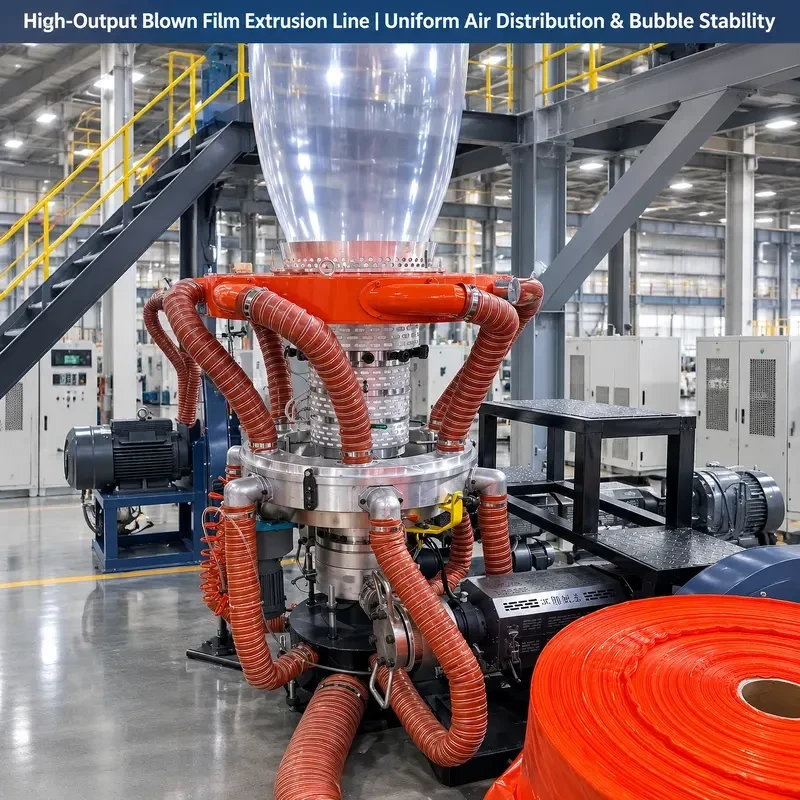
Engineering guide to silicone coated fiberglass ducting on blown film lines: uniform multi-port air ring supply, blower manifold vibration isolation, radiant heat near the die, -70 °C to +260 °C with +300 °C peaks, for gauge uniformity and bubble stability.
On a blown film line the silicone duct between the blower and the air ring is a precision airflow component, not a flexible connector. It sets how evenly cooling air reaches the air ring, how much blower vibration reaches the die, and how much radiant heat the cooling air picks up on the way. Silicone-coated fiberglass ducting holds that duty from -70 °C to +260 °C, with short-term peaks to +300 °C.
Film gauge, bubble stability and line speed all follow from the same three variables: air volume, air velocity and air temperature, delivered symmetrically around the circumference. The duct is the part that decides whether those three stay equal at every port.
Why the Duct Decides Film Gauge
Molten polymer leaves the annular die at roughly 180 °C to 260 °C and expands into a bubble. Cooling air from the air ring solidifies the melt at the frost line. If one segment of the ring delivers slightly more air, or air a few degrees cooler, the frost line rises locally, that section is drawn thinner, and the roll comes off with gauge banding and uneven optics.
No air ring can correct a supply imbalance upstream of itself. So the duct run has to be dimensionally identical port to port, hold its bore under blower pressure, and not leak or throttle at a bend.
Multi-Port Air Ring Distribution
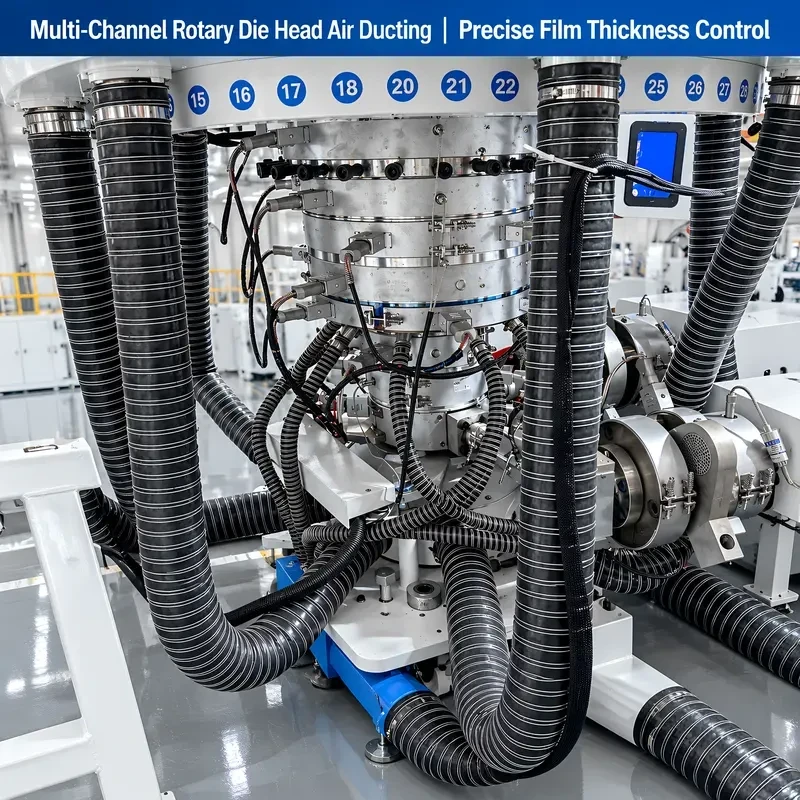
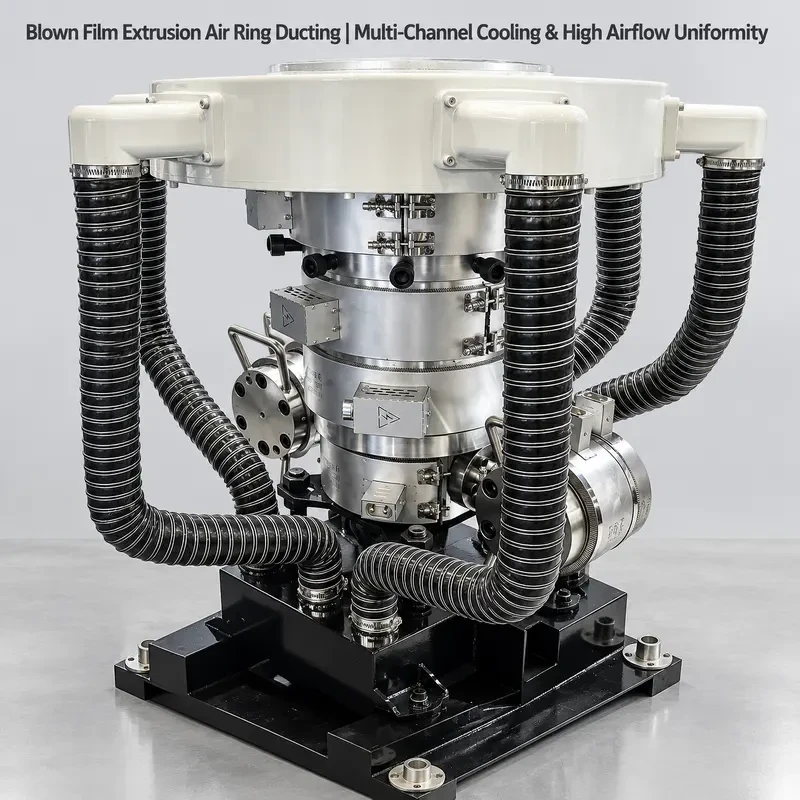
Multi-port air rings typically use 8 to 24 symmetric entry points, each fed by its own flexible line from a common manifold. Four properties make that work:
- Identical bore. The same internal diameter on every leg keeps dynamic pressure equal at each port.
- Smooth bore. Lower friction means less pressure drop across a short, tightly bent run.
- No collapse at the bend. A duct that flattens at a tight radius throttles that port only, which is exactly the asymmetry the ring was designed to remove.
- Stable wall under pressure. Blower discharge is positive pressure; the wall must not flutter or balloon, because both change the effective flow area.
Blower Manifold and Vibration Isolation
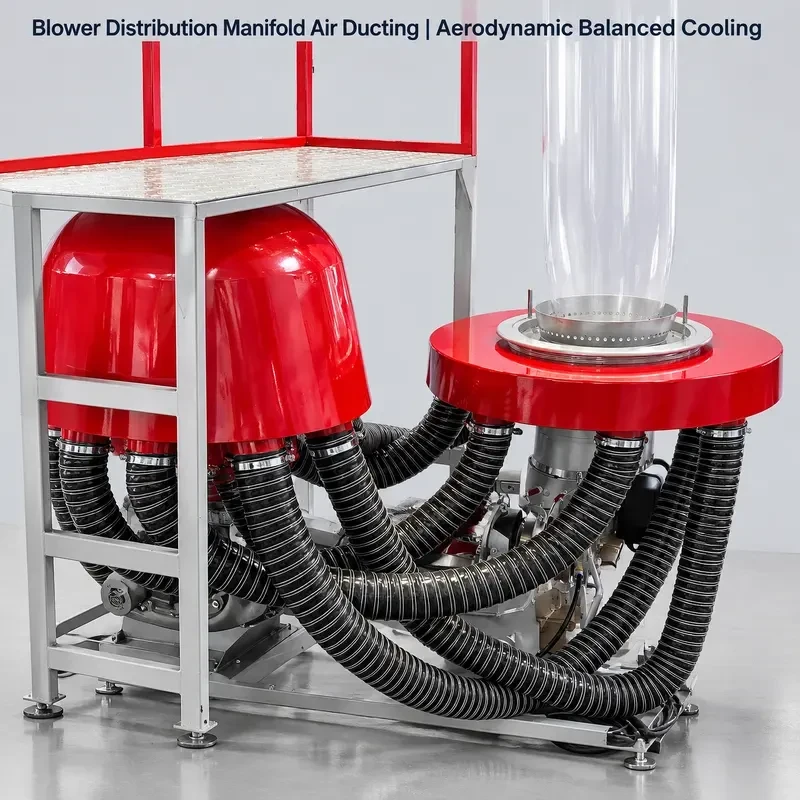
A high-speed centrifugal blower transmits vibration through anything rigidly connected to it. If that path ends at the die head, the vibration appears as harmonic flutter on the molten bubble and as fine horizontal marks on the film surface, which show up in the optics long before the operator can hear anything wrong.
The elastomer wall of a silicone duct interrupts that path. The fabric and coating absorb high-frequency movement while the steel helix keeps the bore open, so the duct acts as a damper rather than a transmission line. That is why the flexible section belongs close to the blower outlet as well as at the ring.
Radiant Heat and Chilled Air
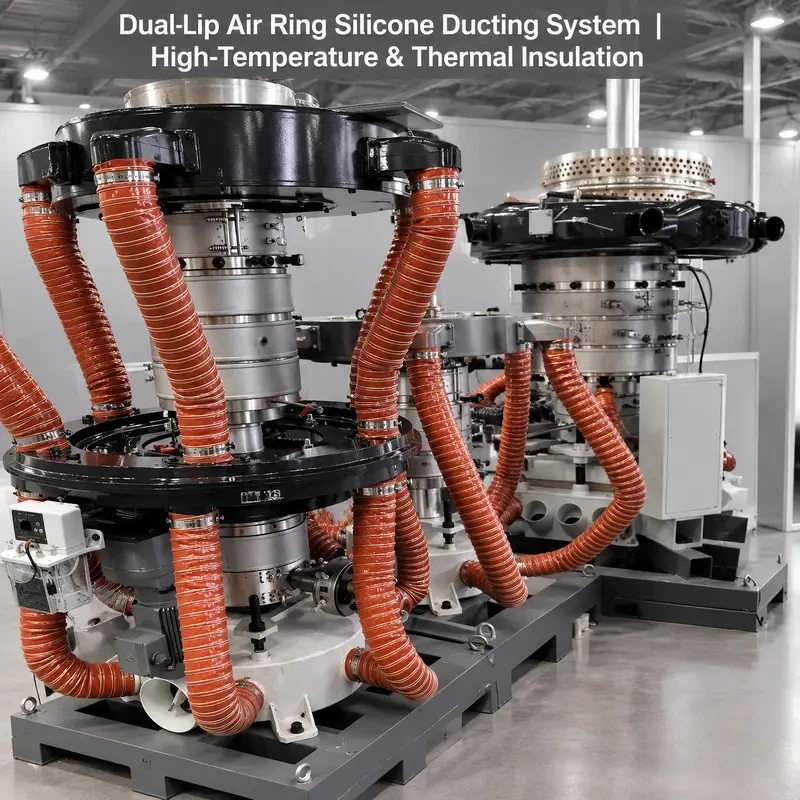
Die heads and their heater bands run between roughly 180 °C and 300 °C. The ducts feeding the ring pass close to that hardware, and on most lines there is no room to add a heat shield.
PVC and standard rubber soften, blister or harden in that radiant field. A silicone-coated fiberglass wall tolerates the radiant load without embrittling, and because silicone has low thermal conductivity, it also limits how much heat reaches the air inside.
That second effect matters more than it sounds. Many high-output lines run chilled air at about 10 °C to 18 °C to push the frost line down and raise throughput. A duct that conducts heat into that stream warms the air before it reaches the lip, quietly cancelling part of the chiller capacity. The insulation value of the wall is part of the cooling budget.
Rotary and Oscillating Die Heads
To avoid gauge bands aligning with the same clock position on the roll, many lines rotate the die or oscillate the air ring through a full revolution. The duct at that joint therefore bends and twists continuously for the life of the machine.
Two construction details carry that duty: a high-tensile spring steel helix, which prevents the wall taking a permanent set and stops the fabric unravelling at a repeated fold, and enough axial flexibility to fit a vertical multi-channel bundle without fighting the thermocouple wires, heater harnesses and pressure transducers that share the same space.
Bubble Stability at High Output
At several hundred kilograms per hour the bubble is being cooled hard, and a small imbalance becomes a visible sway. A symmetric, stable air supply holds the bubble against the air collar and keeps frost line height steady during acceleration, which is when most film breaks happen.
The material also matters for what it does not add. A silicone-coated fiberglass wall contains no plasticiser and no halogen, so it does not release plasticiser vapour or airborne particulate into the cooling stream. For food packaging, medical barrier film and optical substrates that is a practical advantage, though the final cleanroom or food-contact determination still rests on your film compliance testing.
Material Comparison
| Property | Silicone coated fiberglass | PVC flexible duct | PU duct |
|---|---|---|---|
| Continuous temperature | -70 °C to +260 °C (short-term +300 °C) | About -10 °C to +60 °C | -40 °C to +90 °C (short-term +125 °C) |
| Near die heater bands | Suitable | Softens, hardens or blisters | Moderate, softening risk at close range |
| Thermal insulation | High, helps hold chilled air | Low | Low to moderate |
| Oscillation fatigue | Good, steel helix supported | Low, kinks and fatigues | Good |
| Plasticiser and odour | No plasticiser, low odour | Plasticiser can migrate and smell | Low |
| Flame retardancy | Flame-retardant construction, report on request | Varies by compound | Flame-retardant grades available |
Typical Construction and Specifications
| Parameter | Specification |
|---|---|
| Wall | Single-ply or double-ply silicone-coated woven fiberglass |
| Reinforcement | Embedded high-tensile spring steel wire helix |
| External protection | Silicone glass fibre cord, abrasion resistant |
| Temperature | -70 °C to +260 °C, short-term peaks to about +300 °C |
| Pressure duty | Positive blower discharge and vacuum, wall stable without flutter |
| Bending | Tight radius without collapse, suited to vertical multi-channel runs |
| Options | Custom bore, length, colours and end cuffs for machine builders |
Frequently Asked Questions
Why silicone ducting rather than aluminium or PVC for an air ring?
Silicone-coated fiberglass tolerates radiant heat up to +260 °C continuous without softening or burning, absorbs blower vibration, and flexes with an oscillating die. Rigid aluminium transmits vibration and cannot follow the ring, while PVC embrittles and carries plasticiser.
How does the duct improve thickness uniformity?
It keeps the bore round and identical on every leg under blower pressure, so each ring port receives the same volume at the same temperature. Even cooling is what holds gauge tolerance.
What construction is used for air ring hoses?
Single-ply or double-ply silicone-impregnated woven fiberglass, vulcanised over a high-tensile spring steel helix, usually with an external silicone glass cord for abrasion resistance.
Can the duct run close to the die heater bands?
Yes, that is the normal installation. Keep it out of direct contact with hot metal and confirm the actual surface temperature in your machine layout.
Does it insulate chilled cooling air?
The silicone fiberglass wall has low thermal conductivity, which limits heat gain from the die area and helps the air arrive at the ring near its set temperature.
How long does it last on a rotating die head?
Life depends on rotation speed, bend radius and temperature. The steel helix prevents permanent deformation, and the duct is replaced when the wall softens or the helix shows at a fold, not on a fixed calendar.
Is the material suitable for food packaging film lines?
The wall contains no plasticiser and no halogen, which supports clean operation. Final acceptance for food contact or cleanroom classification depends on your film and machine validation, so confirm the documentation you need with us.
Can you supply ducts for a machine builder programme?
Yes. Custom bore, length, colour, cuff and marking are available, with single and double ply constructions to suit the die layout.
Next Step
For the wider family see the silicone ducting range. The single layer silicone duct guide covers construction detail, the EISD silicone ducting guide covers the heavier high-temperature build, and the clamped double-ply duct guide covers the wear-strip version for floor duty. Send your ring port count, blower pressure and die layout to the ECOOSI technical team for a duct schedule.
Related Articles
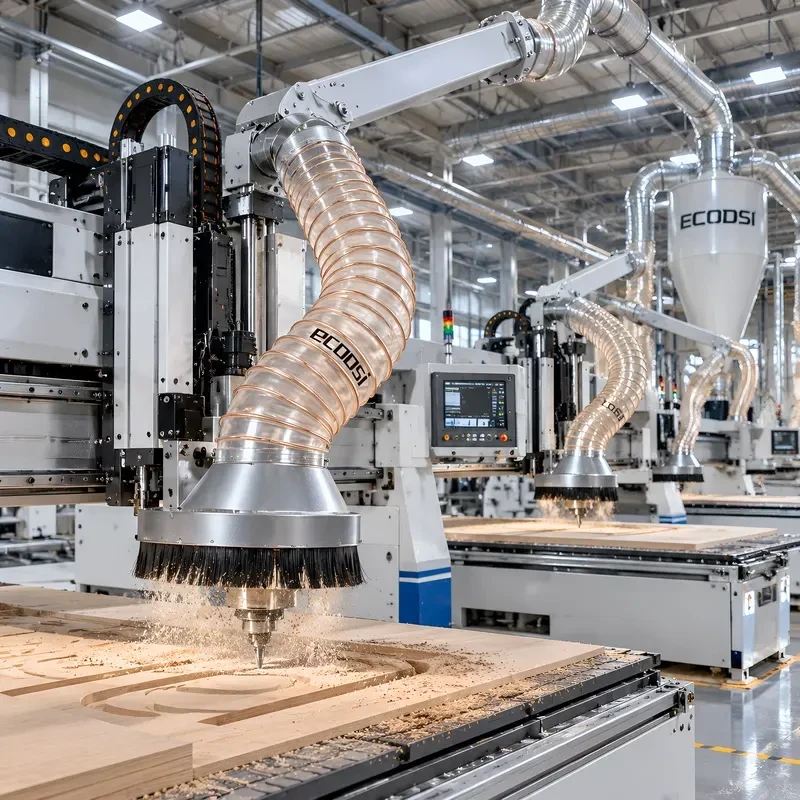
Antistatic PU Woodworking Dust Collection Hose: CNC and Sawdust Extraction Guide
Guide to ECOOSI antistatic PU woodworking dust collection hose: copper wire helix, flame-retardant abrasion-resistant polyurethane, -40 °C to +90 °C with +125 °C peaks, 4:1 compressible, for CNC routers, panel saws and sawdust extraction.
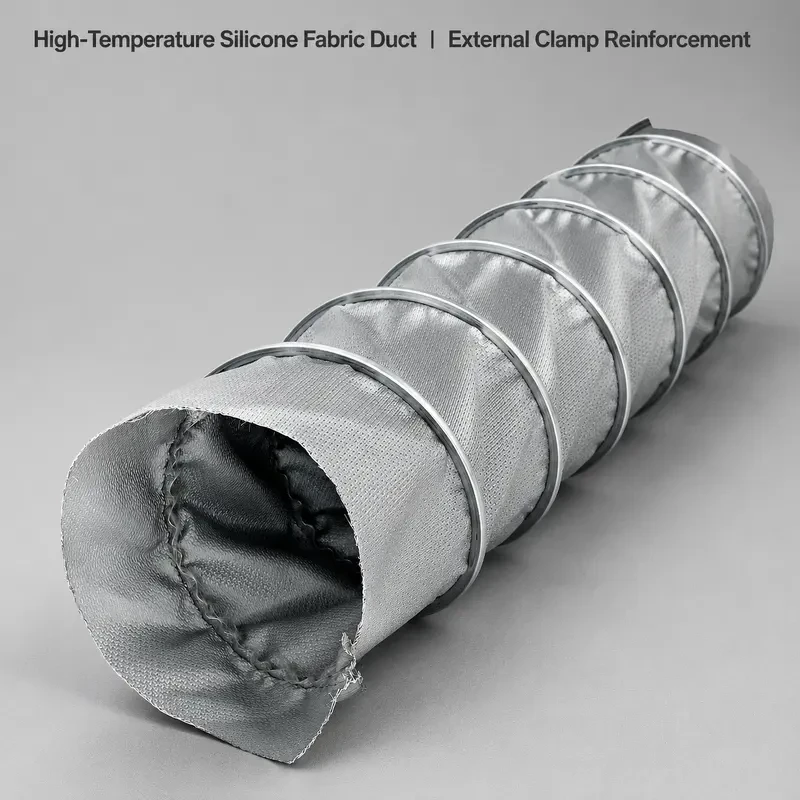
Clamped Double-Ply Silicone Fiberglass Duct: 400 °C High-Temperature Hose Guide
Guide to ECOOSI clamped double-ply silicone coated fiberglass high-temperature ducting: external galvanized steel clip wear strip, -80 °C to +400 °C with +450 °C peaks, 10:1 compressible, 38 to 1000 mm bore for foundry fume, kilns and dyno cells.
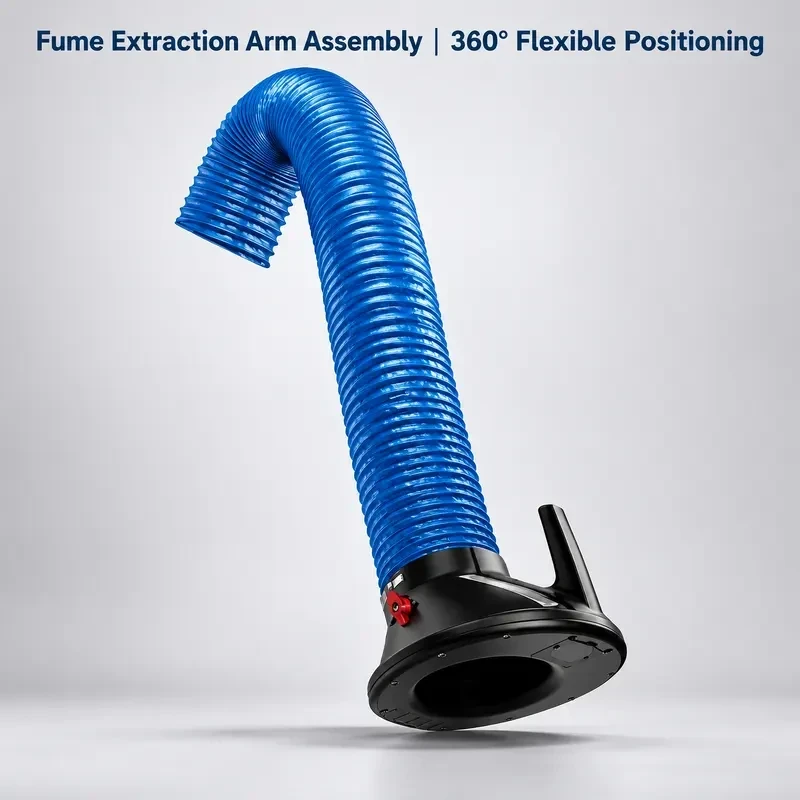
Super-Light PVC Coated Fabric Fume Extraction Hose: 10:1 Compressible Welding Duct Guide
Guide to ECOOSI super-light PVC coated fabric fume extraction hose: 0.35 mm wall, 10:1 axial compression, spring steel helix with static grounding, -10 °C to +80 °C with +100 °C peaks, 38 to 406 mm bore for welding fume arms and light dust collection.