
Antistatic PU Woodworking Dust Collection Hose: CNC and Sawdust Extraction Guide
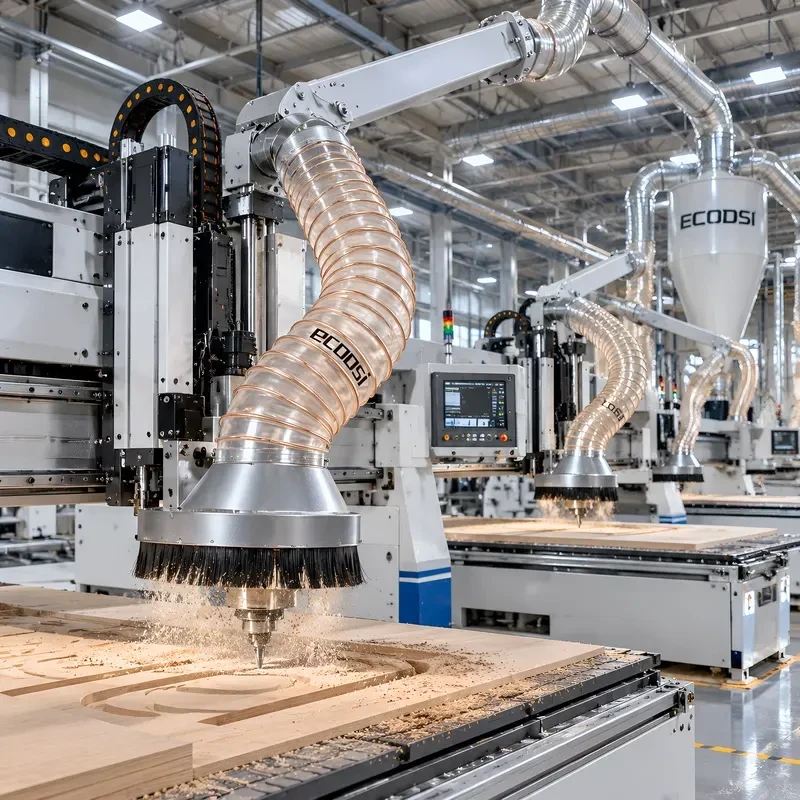
Guide to ECOOSI antistatic PU woodworking dust collection hose: copper wire helix, flame-retardant abrasion-resistant polyurethane, -40 °C to +90 °C with +125 °C peaks, 4:1 compressible, for CNC routers, panel saws and sawdust extraction.
The ECOOSI woodworking dust hose is a transparent polyurethane duct with an embedded copper wire helix, a flame-retardant and abrasion-resistant wall, and a service range from -40 °C to +90 °C with short-term peaks to +125 °C. It is axially compressible at about 4:1 and is used on CNC router heads, edge banders, panel saws and central sawdust extraction lines.
Wood dust brings two problems at once: it is abrasive, and it is combustible. The hose has to survive sharp chips at speed and it has to be part of a static control strategy, not an accessory bolted on afterwards.
Why Wood Dust and Static Are a Safety Pair
Dry chips and sawdust moving at 20 m/s or more rub against the duct wall continuously. On an insulating hose that friction builds a charge on the wall, and a discharge in a stream of fine airborne dust is exactly the ignition source a dust hazard assessment is trying to remove.
An antistatic hose gives the charge a path. In this construction a copper wire helix runs through the wall and can be bonded to earth at both ends, so charge moves to ground instead of accumulating.
Be precise about what that does and does not do. It reduces static accumulation in the duct. It does not make a dust line non-explosive, and it does not replace correct extraction velocity, bonded metalwork, housekeeping or a dust hazard assessment under the applicable standard for your site.
Construction
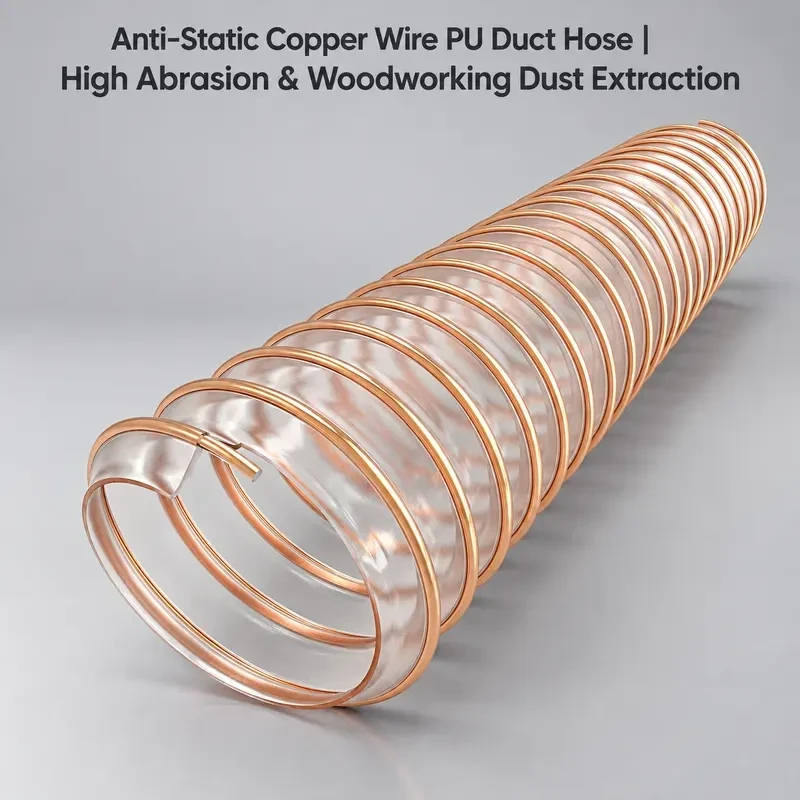
| Element | Material | Function |
|---|---|---|
| Wall | Flame-retardant polyurethane | Abrasion resistance, flexibility, transparency |
| Reinforcement | Embedded copper wire helix | Antistatic path, hoop support against collapse |
| Bore | Smooth PU | Low friction, less dust cling, higher transport velocity |
| Body | Corrugated, about 4:1 compressible | Flex on moving heads, compact transport |
The clear wall is a practical extra on a dust line. You can see a bridge forming at a bend, or a slug of chips travelling down the duct, before the machine loses extraction and the cutter starts packing dust around the spindle.
Why Polyurethane for Wood Chips
Wood chips are not round. A planer produces curls with a cutting edge, a router produces splintered chips and a sander produces a fine abrasive powder. All three attack the wall from the inside.
PU combines high tear strength with elasticity, so an impact deforms the wall and it recovers instead of cutting through. A softer wall would groove and then split at the groove. This is why PU is the usual choice for CNC extraction while a general ventilation duct is not.
On a Moving CNC Head
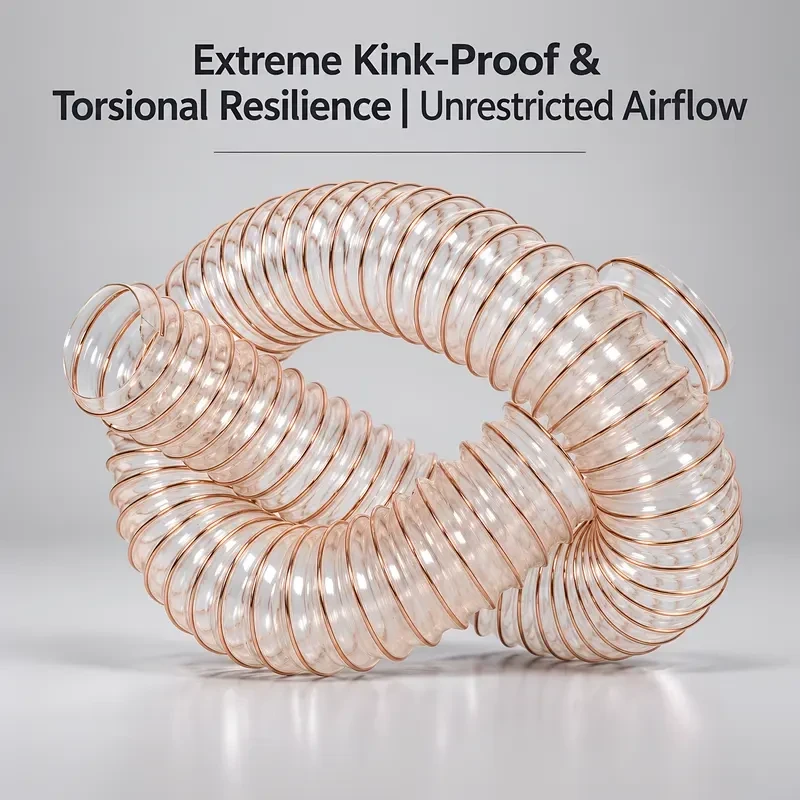
A router head accelerates, stops and reverses thousands of times a shift, and the hose has to follow without snatching at the gantry or folding into a flat spot. Two properties matter: a tight bend radius, and enough torsional resilience that the duct does not twist itself closed over a long run.
A kinked section is worse than a small bore, because it also collects dust. The helix keeps the section round through the working envelope, and the wall returns to shape after being stretched at full travel.
Compression and Installation
An axially compressible duct solves a specific problem in machine building: the distance between the hood and the fixed main is rarely exact. The hose can be pushed short to fit, then extended to take up tolerance without a custom length.
Compression also cuts freight volume, which matters on orders of long runs, and it makes a spare duct something a maintenance technician can carry to the machine rather than book a pallet for.
Size Range
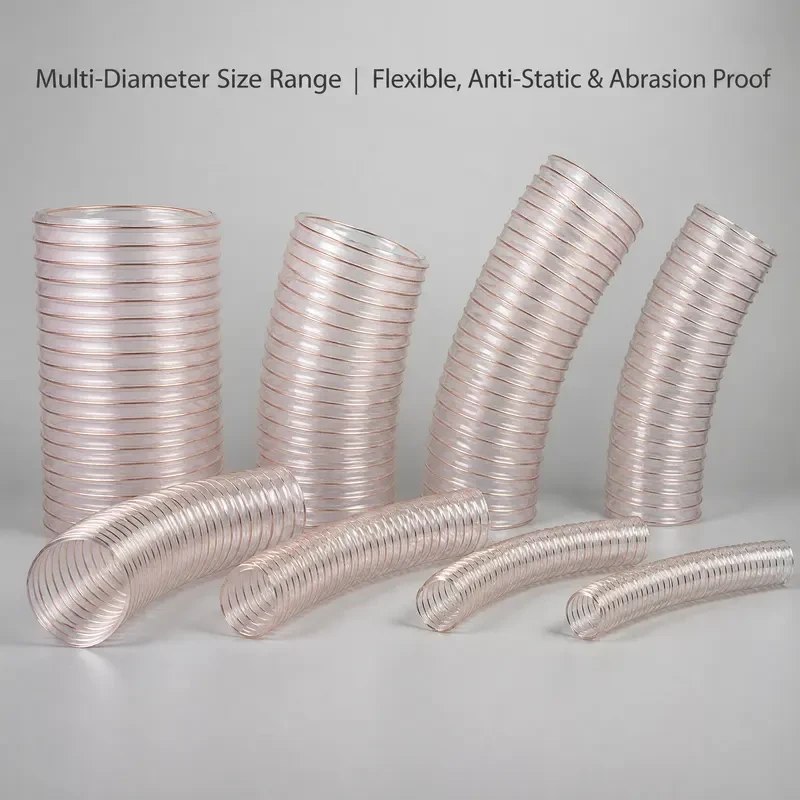
Small bores suit a single brush hood at the cutter; larger bores suit the manifold or the main run to the filter. Size by transport velocity rather than by the port: below roughly 18 to 20 m/s in a horizontal run, chips start dropping out and the duct becomes a settling chamber.
Machine Examples
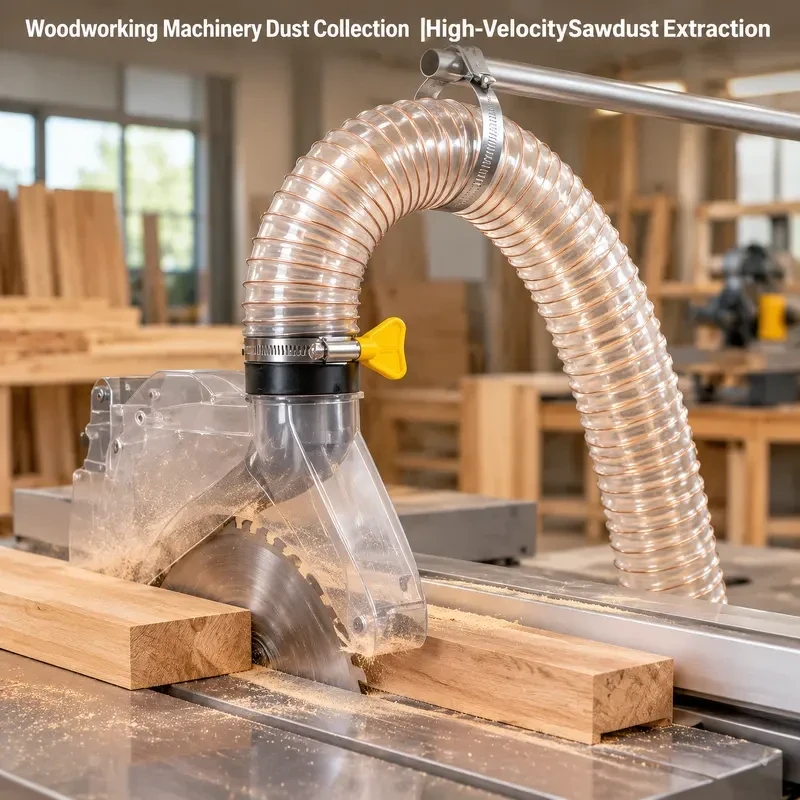
- CNC routers and machining centres. Head-mounted drops to brush hoods, with enough travel for the full working envelope.
- Edge banders and panel saws. Short flexible connections at the cutting point where a rigid pipe would foul the guard.
- Planers, jointers, sanders and thicknessers. Machine outlet to branch, where the chip load is heaviest.
- Central extraction. Branch and manifold runs to the filter or silo, including bark dust and dry sawdust.
- Industrial vacuum and conveying. Abrasive particulate suction on automated woodworking lines.
Specifications
| Parameter | Specification |
|---|---|
| Series | PU woodworking dust and woodchip collection hose |
| Material | High-grade polyurethane, flame retardant |
| Safety features | Antistatic copper wire helix, flame-retardant wall, high abrasion resistance |
| Flexibility | Highly flexible, lightweight |
| Compression | About 4:1 axial |
| Temperature | -40 °C to +90 °C, short-term to +125 °C |
| Media | Woodchips, sawdust, shavings, abrasive granules, combustible bulk dust |
| Options | Custom diameters, lengths, colours and branding |
Getting the Static Control Right
- Bond the helix at both ends to a metal cuff or fitting, and check continuity with a meter after installation.
- Earth the machine and the duct run to the same point, per your site electrical standard.
- Keep the extraction on during cutting, not only after, because the cloud forms at the cutter.
- Do not substitute a plain hose for a damaged antistatic duct; the wire is the safety feature.
- Clean settled dust from ledges and floor; the duct only controls what it captures.
- Record the check with the rest of the dust extraction inspection so a broken bond is found before it matters.
Frequently Asked Questions
Why does woodworking dust collection need an antistatic hose?
Dry chips and dust generate static as they rub against the wall at speed. A copper helix bonded to earth gives that charge a path, which reduces the risk of a discharge in a combustible dust stream.
Does an antistatic hose make the system explosion proof?
No. It is one element of static control. Extraction velocity, bonded metalwork, housekeeping and a dust hazard assessment under the applicable standard are also required.
What temperature can the hose handle?
-40 °C to +90 °C continuous, with short-term peaks to +125 °C.
How much does it compress?
About 4:1 axially, which helps with installation tolerance and transport volume.
Will it resist sharp wood chips?
Yes. Polyurethane combines tear strength with elasticity, so chip impacts deform the wall instead of cutting into it.
Can I see blockages?
The wall is transparent, so bridging at a bend or a slug of chips is visible before extraction is lost.
Which diameter should I choose?
Size for transport velocity in the run. Small bores for a hood drop, larger bores for branches and mains; keep horizontal runs above roughly 18 to 20 m/s.
Do you supply custom lengths and branding?
Yes. Custom diameters, lengths, colours and private labelling are available.
Next Step
For the wider range see the PU ducting range. For explosion-protected ventilation ductwork the explosion-proof antistatic duct guide covers the fabric construction, and the anti-static PU material handling guide covers bulk solids outside woodworking. Send your machine, hood size and extraction airflow to the ECOOSI technical team for a duct and diameter recommendation.
Related Articles
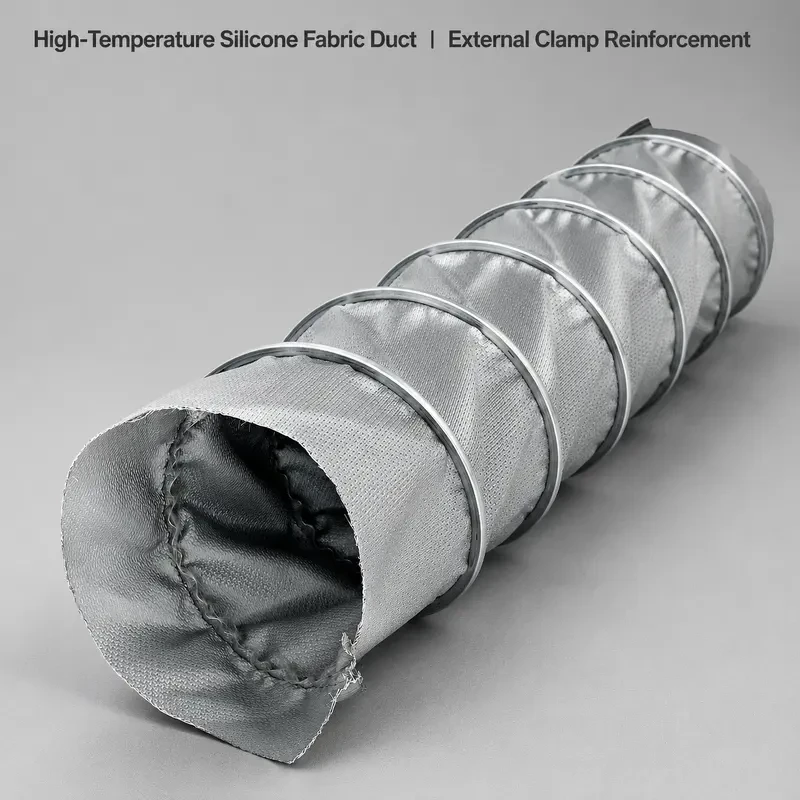
Clamped Double-Ply Silicone Fiberglass Duct: 400 °C High-Temperature Hose Guide
Guide to ECOOSI clamped double-ply silicone coated fiberglass high-temperature ducting: external galvanized steel clip wear strip, -80 °C to +400 °C with +450 °C peaks, 10:1 compressible, 38 to 1000 mm bore for foundry fume, kilns and dyno cells.
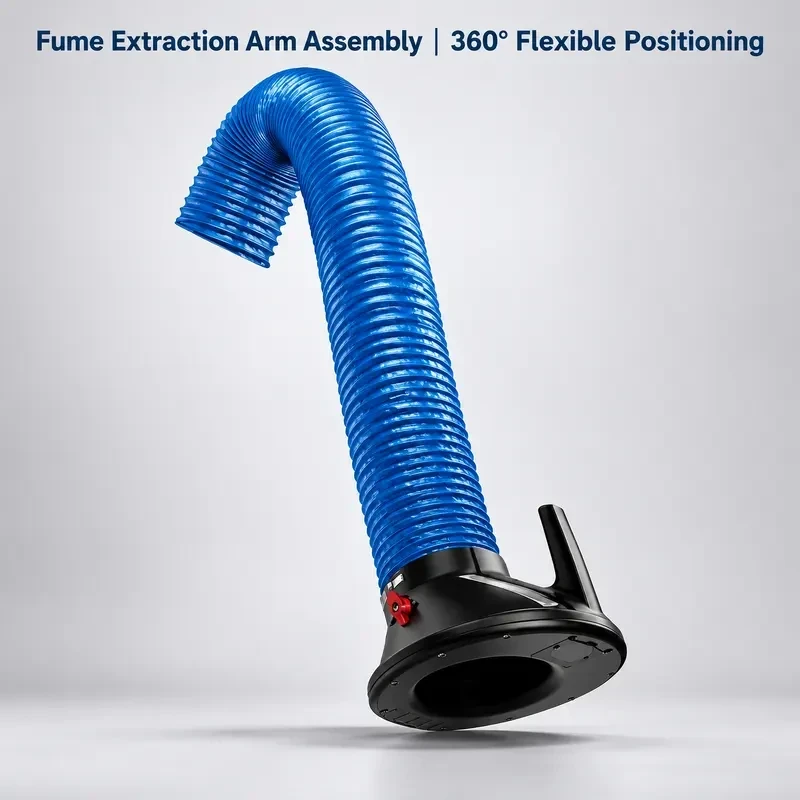
Super-Light PVC Coated Fabric Fume Extraction Hose: 10:1 Compressible Welding Duct Guide
Guide to ECOOSI super-light PVC coated fabric fume extraction hose: 0.35 mm wall, 10:1 axial compression, spring steel helix with static grounding, -10 °C to +80 °C with +100 °C peaks, 38 to 406 mm bore for welding fume arms and light dust collection.
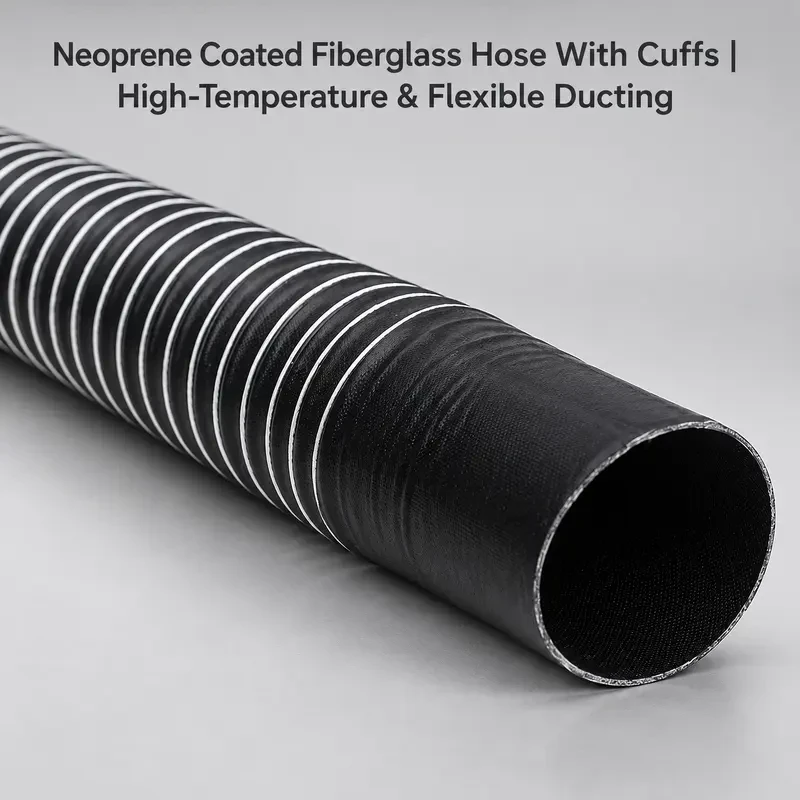
Neoprene Air Intake Hose for New Energy Vehicles: Wire-Reinforced EV Duct Guide
Guide to ECOOSI black neoprene air intake hose for NEV and EV platforms: spring steel wire helix, corrugated body for vibration isolation, -40 °C to +135 °C with +150 °C peaks, 38 to 203 mm bore for air cleaners, battery pack cooling and motor cooling ducts.