
Anti-Static PU Material Handling Hose: Copper Wire Helix Guide for Grain, Sand and Plastic Pellets
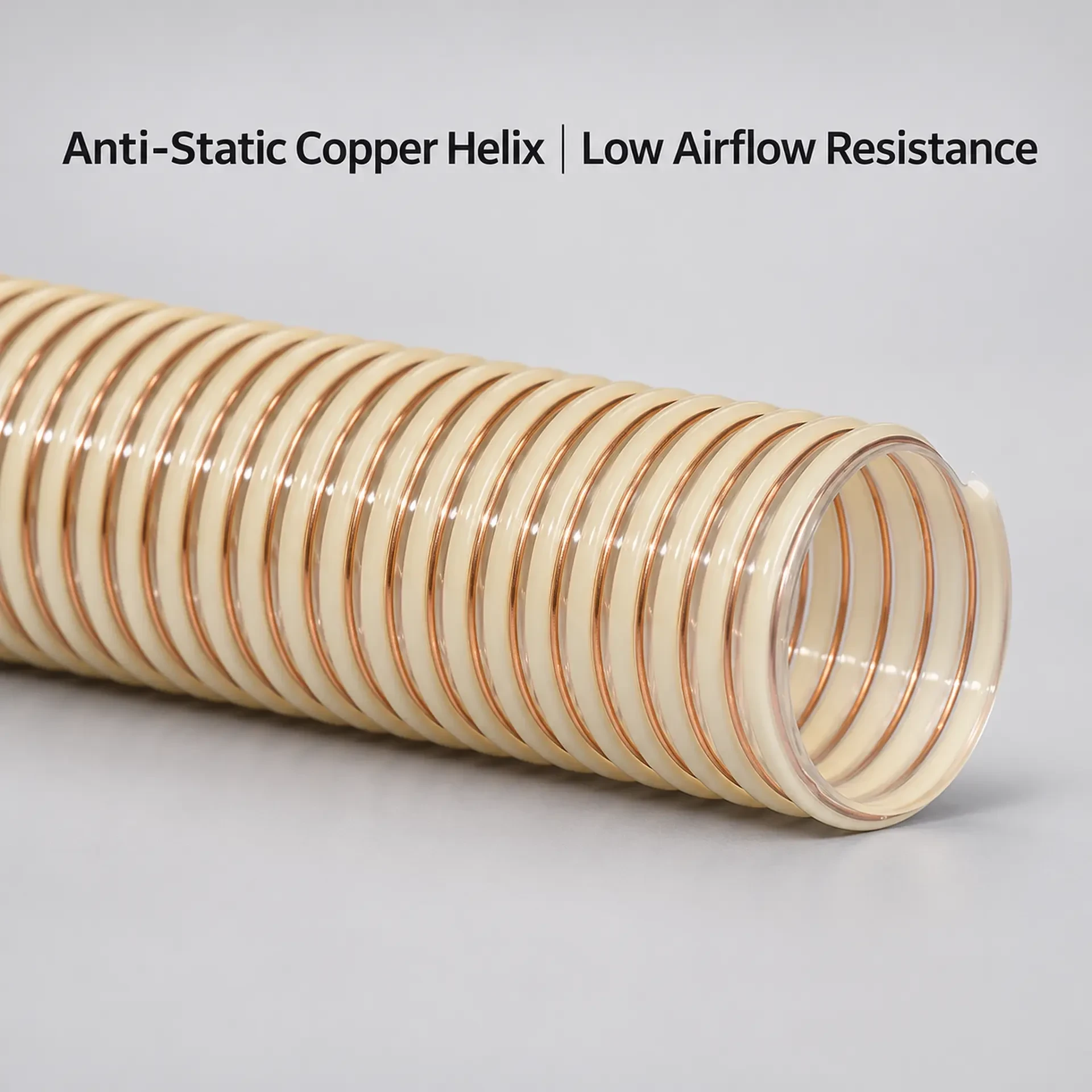
Guide to the ECOOSI anti-static polyurethane material handling hose: rigid PVC helix, embedded copper grounding wire below 10^8 ohm, smooth bore, -40 to +90 °C with peaks to +125 °C, 25-300 mm bore for grain, sand, plastic pellets and wood chips.
The ECOOSI anti-static PU material handling hose is a transparent ester-based polyurethane hose with an embedded rigid PVC helix and a copper grounding wire. Surface resistance stays below 108 Ω, so static generated by dry bulk solids moving through the bore can be taken to earth when the copper wire is grounded at both ends. The working range is -40 °C to +90 °C with intermittent peaks to +125 °C, bore sizes run from 25 mm to 300 mm, and standard supply is 20 m coils.
This guide explains the construction, the static dissipation path, abrasion and flow behaviour, the specifications that matter, and the applications the hose is specified for.
Why Static Builds Up in Pneumatic Conveying
Dry granules moving fast through a non-conductive wall rub against the bore and transfer charge. In a plastic pellet line, a grain auger or a shot blasting recovery system the charge has nowhere to go, so it accumulates on the hose surface and on the material itself. The practical consequences are familiar to anyone running such a line:
Operators get a shock when they touch the hose or the machine frame.
Dust and fine particles cling to the wall, narrowing the bore and bridging at bends.
In dust-laden air, a discharge can become an ignition source.
A dissipative hose does not stop charge from forming. It gives the charge a controlled path to earth, which is why the copper wire and the way it is grounded matter as much as the compound.
Construction: Rigid PVC Helix, Copper Wire, PU Wall
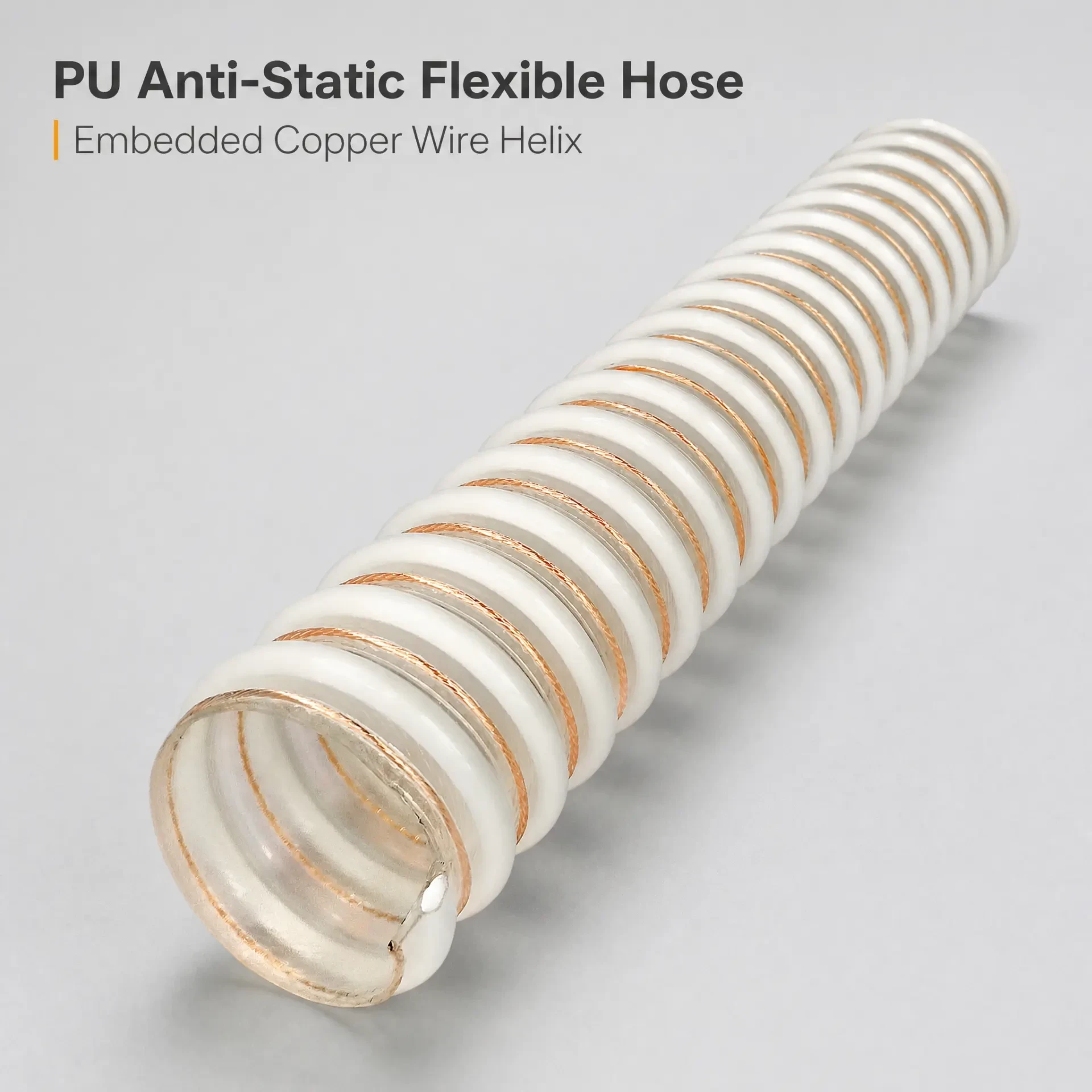
The hose in section: white rigid PVC helix outside, copper wire embedded beside it, transparent PU wall inside.
Layer | Material | Function |
|---|---|---|
Outer helix | Rigid PVC spiral | Crush and vacuum resistance, takes ground drag and impact |
Grounding line | Copper wire, embedded | Dissipative path to earth, surface resistance below 108 Ω |
Tube wall | Ester-based polyurethane | Abrasion resistance, flexibility, visual flow monitoring |
Inner surface | Smooth PU bore | Low friction, reduced material hang-up |
The rigid PVC helix is the structural element. It keeps the bore open under vacuum, so the hose does not flatten and choke the line when a vacuum loader pulls hard, and it forms a raised rib that protects the wall when the hose is dragged across a floor. The copper wire runs alongside the helix, embedded in the wall rather than loose inside the bore, so conveyed material does not wear or catch on it.
How the Static Dissipation Path Works
The hose is rated dissipative rather than conductive. Surface resistance is below 108 Ω, which is the usual range specified for dust and bulk handling where charge should bleed away gradually instead of discharging in a spark.
Two conditions have to be met for the rating to mean anything in service:
The copper wire must be connected to earth. An ungrounded anti-static hose behaves much like a standard hose and can still hold charge.
Both ends should be bonded, and the machine frame, hopper or vacuum unit connected to the same earth. Check continuity with a meter after installation.
Where the installation falls under ATEX or a local dust hazard assessment, the earthing scheme is part of the risk assessment and should be verified by the responsible engineer, not assumed from the hose datasheet.
Anti-static copper helix and smooth bore: the two features that carry the static and the flow duty.
Smooth Bore, Abrasion Resistance and Flow
The bore is mirror-smooth, not corrugated on the inside. Two things follow. First, friction against the wall is low, so pressure drop along the run stays modest and the blower or vacuum unit works less. Second, pellets and granules slide instead of tumbling into the helix valleys, which reduces the build-up that eventually bridges a line.
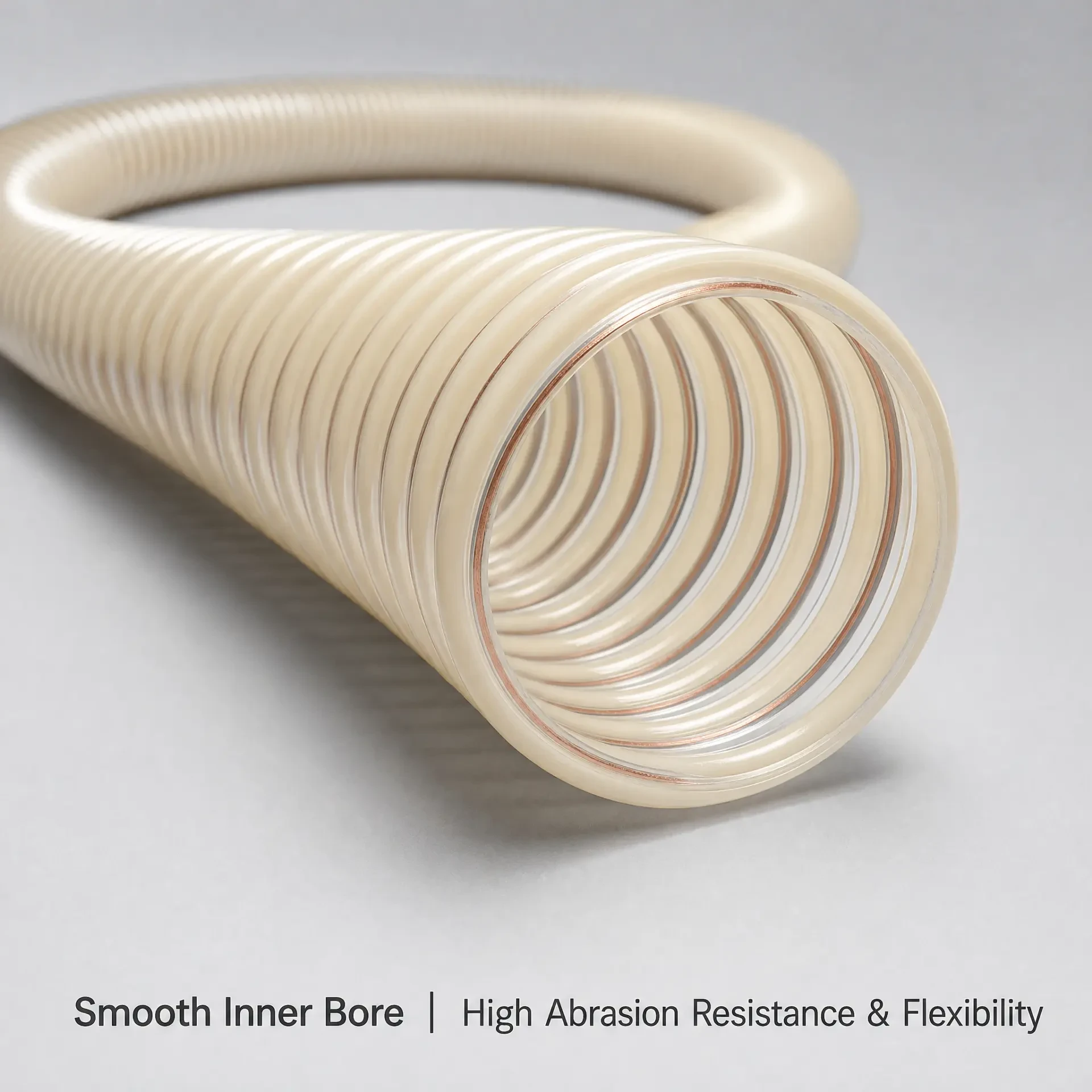
Smooth inner bore with the helix visible through the wall: low friction and visual flow monitoring.
Ester-based polyurethane is chosen for wear life. Against sand, gravel, plastic pellets, grain and wood chips it lasts considerably longer than a standard PVC hose of the same wall thickness, which is the main reason PU is specified on abrasive conveying duty. Wall thickness is selected by duty: 0.6 mm for light transfer, medium wall for general conveying, and up to 2.0 mm where the media is sharp or the hose is dragged.
Temperature Range
Continuous service is -40 °C to +90 °C, with intermittent peaks up to +125 °C. In practice the low end matters as much as the high end: PU keeps its flexibility in winter conditions where a rigid PVC hose stiffens and can crack at the helix. If the material arrives warm from a dryer or a pelletizer, check the actual media temperature at the hose inlet rather than the process set point.
Applications
Agriculture and grain handling
Pneumatic transfer of wheat, corn, seed, animal feed and fertiliser. The smooth bore keeps kernels moving and the dissipative wall handles the charge that dry grain generates in a vacuum line.
Plastic and resin processing
Resin pellet conveying, hopper loader vacuum lines and masterbatch distribution. Transparent walls let operators see a slug of pellets or a partial blockage before the loader alarms.
Woodworking and furniture
Sawdust extraction, wood chip suction and CNC router dust collection. The hose in the picture below runs from the machine hood to the extraction duct, with the helix taking the flexing at the tool head.
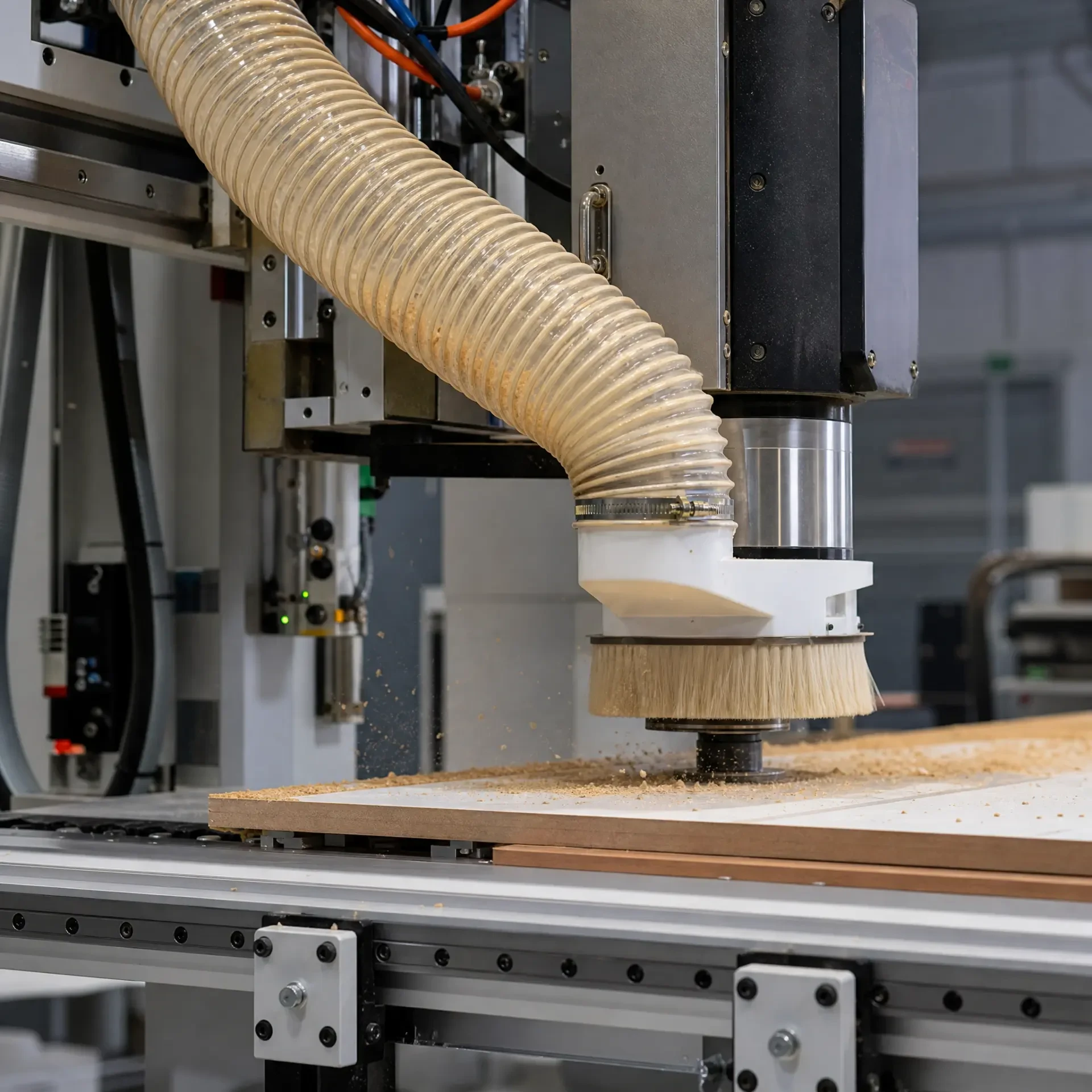
CNC router dust extraction: the hose flexes at the tool head while the helix holds the bore open.
Mining, foundry and construction
Shot blasting recovery, sand, gravel, cement powder and dry mineral suction. This is the heaviest wear duty in the range, so specify the thickest wall and inspect the bore at bends.
Industrial cleaning and cleanroom transfer
Heavy duty commercial vacuums, street sweepers and particulate transfer where the hose has to be moved by hand all day.
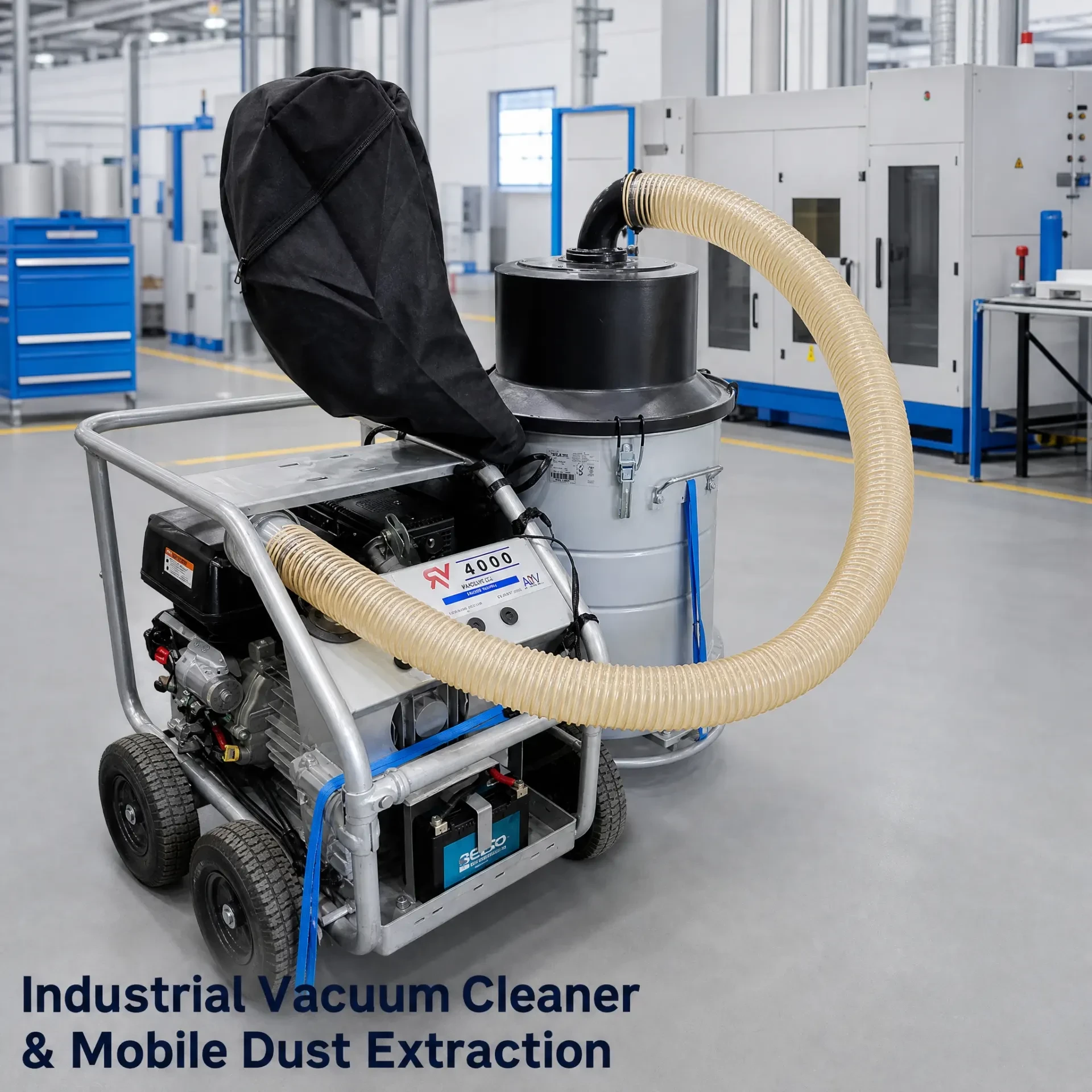
Mobile industrial vacuum: a light, crush-resistant hose that follows the operator around the plant.
Technical Specifications
Parameter | Specification |
|---|---|
Tube wall material | Ester-based polyurethane, halogen-free and plasticizer-free |
Wall thickness | 0.6 mm to 2.0 mm, light, medium and heavy duty options |
Reinforcement | Embedded rigid PVC helix plus copper grounding wire |
Surface resistance | Below 108 Ω, dissipative |
Operating temperature | -40 °C to +90 °C, intermittent peak +125 °C |
Bore sizes | 25 mm to 300 mm standard, metric and imperial |
Standard length | 20 m coils, plain cut ends, custom lengths on request |
Inner surface | Smooth bore, transparent wall |
Chemical resistance | Oil, grease, ozone, UV, hydrolysis and dilute acid or alkali vapours |
Ordering, Packaging and OEM Supply
Hose is supplied coiled, strapped and palletised for export, which keeps the bore from being crushed in transit and lets a distributor store several diameters on one pallet. Diameters, wall thickness, coil length, colour and end fittings can be specified, and OEM orders can be packed to a buyer label.
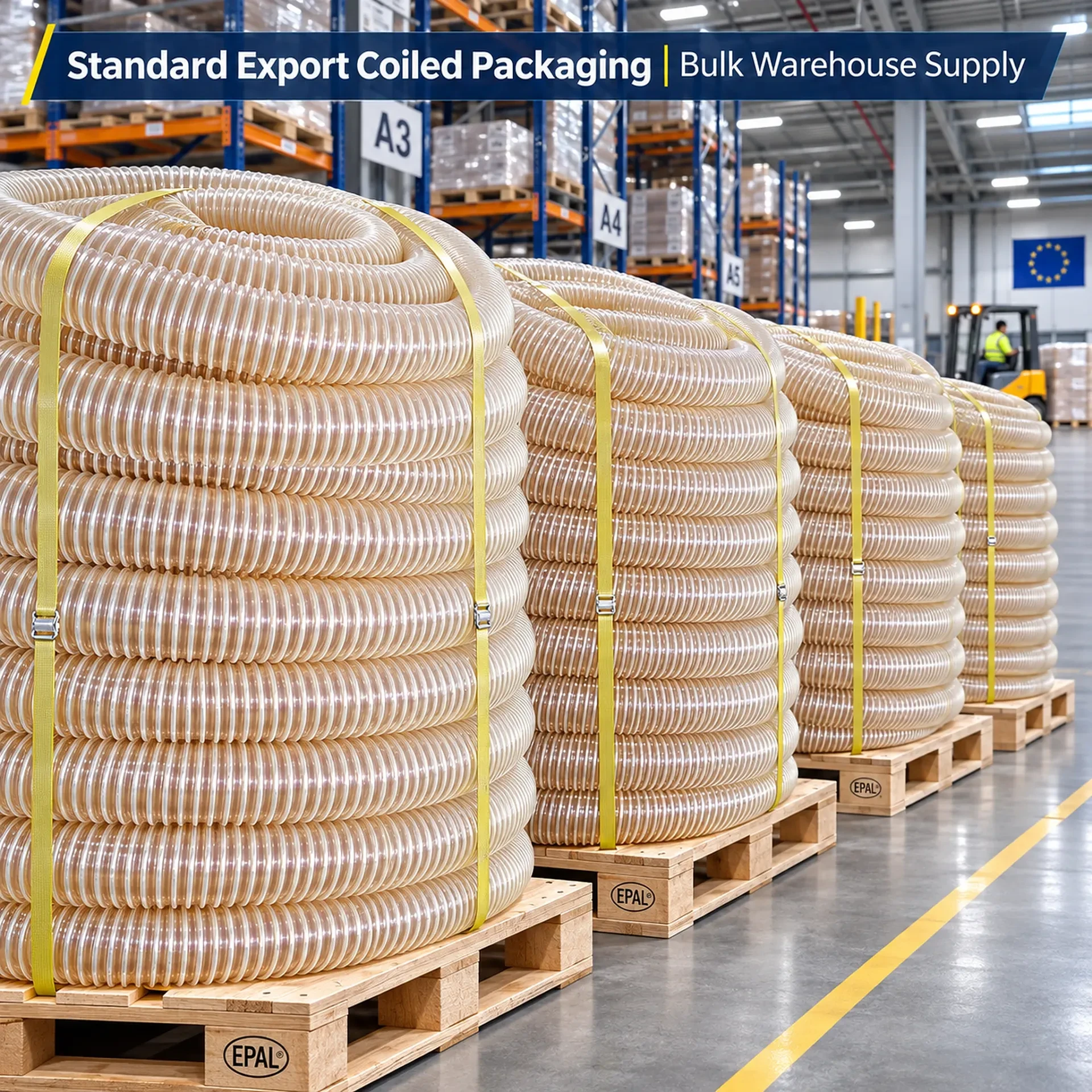
Export packaging: strapped coils on pallets, ready for bulk warehouse supply.
Installation Notes
Ground both ends. Strip a short section of wall at each end, bond the copper wire to earth, and confirm continuity with a meter.
Support long horizontal runs. Sagging adds wear at the low point; a hanger every 1.5 m to 2 m keeps the run straight.
Keep the bend radius generous. A tight bend scrubs the outer wall and is where abrasive hose normally fails.
Use the right cuff. Hose clamps or camlock couplings sized to the bore, with the helix end cut square so the cuff seats.
Inspect the bore at bends. A thin spot shows up as a lighter patch through the transparent wall before it becomes a hole.
Keep hot media within rating. Above +90 °C continuous, specify a high-temperature hose instead of running PU at its peak.
Frequently Asked Questions
What does anti-static mean for a PU hose?
It means the wall is dissipative: surface resistance below 108 Ω, with a copper wire that carries charge to earth. It does not mean the hose can be left ungrounded.
How do I ground the hose correctly?
Connect the copper wire at both ends to the same earth as the machine frame, then check continuity with a multimeter. In dust-hazard areas, follow the site risk assessment.
What materials can it convey?
Grain, seed, feed, plastic pellets, masterbatch, sand, gravel, cement powder, shot, sawdust and wood chips, plus general industrial vacuum duties.
What is the temperature range?
-40 °C to +90 °C continuous, with intermittent peaks up to +125 °C.
Which bore sizes and lengths are available?
25 mm to 300 mm bore as standard, supplied in 20 m coils. Custom metric and imperial sizes and lengths can be made to order.
Is it suitable for vacuum conveying as well as suction cleaning?
Yes. The rigid PVC helix is there specifically to stop the hose collapsing under vacuum. For pressure conveying, confirm the working pressure with us before ordering.
Why is the wall transparent?
So operators can watch material flow and spot a partial blockage, a slug of pellets or a worn patch before it stops the line.
Choosing the Right Hose
If the media is abrasive and the line generates static, this hose is the starting point. The PU ducting range lists the diameters and wall options, the anti-static and explosion-proof duct guide covers ventilation-side static control, and the flexible ducting range covers general air and fume duty. For a wall thickness recommendation or a sample, contact the ECOOSI technical team.
Related Articles
PVC Rubber Grit Hose: Yellow Helix Abrasion-Resistant Suction Guide for Blasting and Duct Cleaning
Guide to the ECOOSI heavy-duty PVC and rubber compound grit hose: soft elastomer wall, rigid yellow PVC helix, mirror-smooth bore, -10 to +60 °C standard or -20 to +80 °C heavy-duty, 51-203 mm bore, 20 m coils for blasting, duct cleaning and slurry recovery.
PVC Braided Suction and Discharge Hose: Fibre-Reinforced Helix Guide for Pumps and Dewatering
Guide to the ECOOSI PVC braided suction and discharge hose: double-ply virgin PVC wall, polyester braid for pressure, rigid orange PVC helix for vacuum, -20 to +65 °C, 25-150 mm bore, 20 m coils for trash pumps, dewatering, tankers and aquaculture.
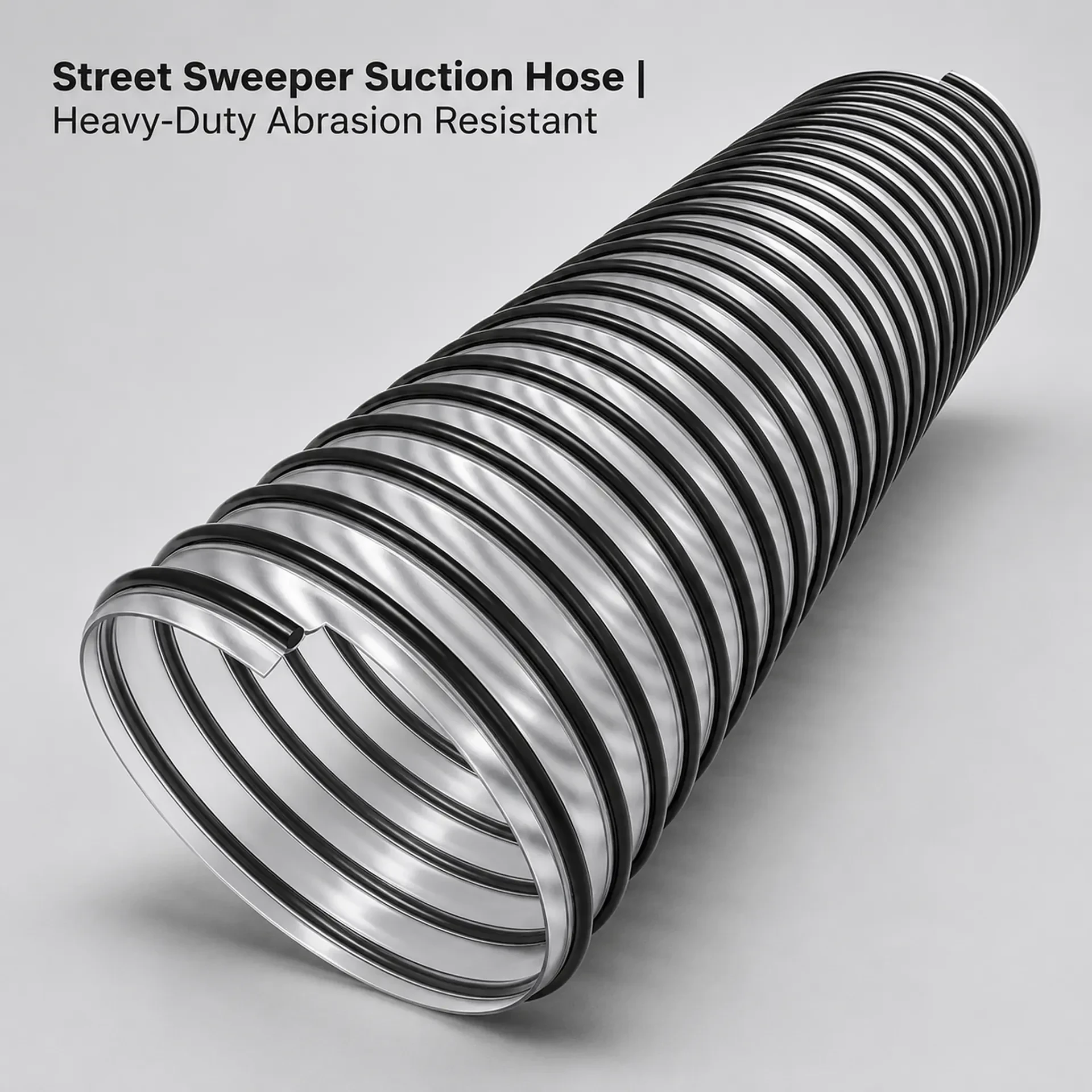
Municipal Street Sweeper PU Suction Hose: Wear-Strip and Copper-Plated Helix Guide
Guide to the ECOOSI heavy-duty polyurethane sweeper hose: 0.9 mm Pre-PUR wall, copper-plated spring steel helix, external black wear strip, -40 to +100 °C with peaks to +125 °C, 10 m coils for street sweepers, runway vacuum trucks and industrial vacuum systems.