
PVC Rubber Grit Hose: Yellow Helix Abrasion-Resistant Suction Guide for Blasting and Duct Cleaning
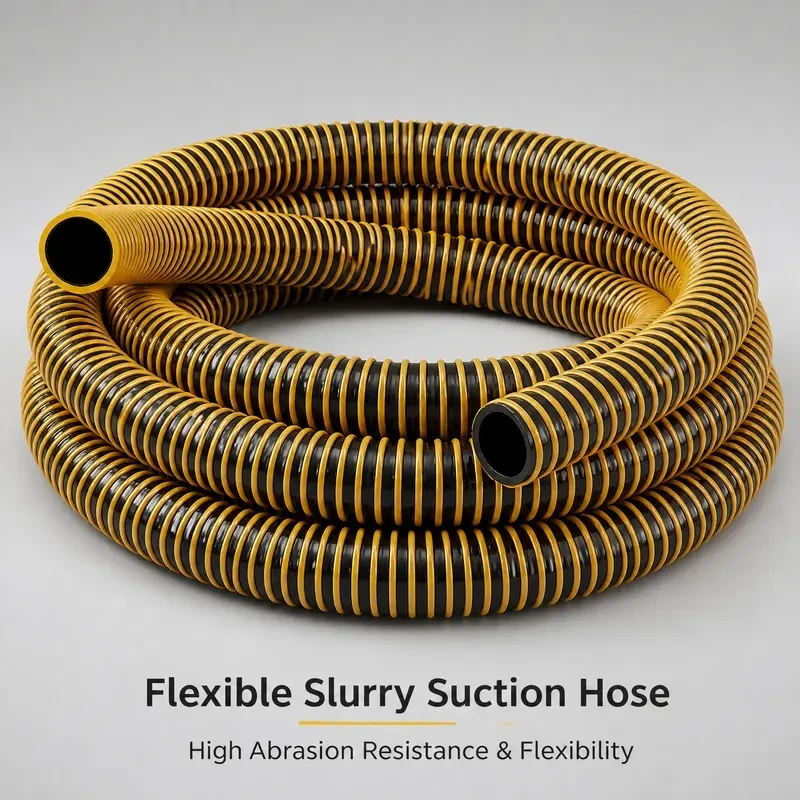
Guide to the ECOOSI heavy-duty PVC and rubber compound grit hose: soft elastomer wall, rigid yellow PVC helix, mirror-smooth bore, -10 to +60 °C standard or -20 to +80 °C heavy-duty, 51-203 mm bore, 20 m coils for blasting, duct cleaning and slurry recovery.
The ECOOSI grit hose is a heavy-duty suction and transfer hose made from a soft PVC and rubber compound wall, reinforced with a rigid yellow PVC helix on the outside. The compound absorbs particle impact where a hard PVC wall would chip, the yellow rib takes ground drag and keeps the hose visible on site, and the mirror-smooth bore keeps abrasive media moving. Standard rating is -10 °C to +60 °C, a heavy-duty variant covers -20 °C to +80 °C, bore sizes run from 51 mm to 203 mm, and standard supply is 20 m coils.
This guide covers where grit hose fails, how the compound and the helix work together, the temperature and pressure limits, and the duties it is specified for.
Where Abrasive Hose Fails
Sand, steel grit, garnet and slag do not cut like a blade. They arrive at speed and hit the wall at an angle, so the failure starts where the flow is forced to change direction: the outside of a bend, and the first half metre behind the nozzle or the pickup head. Two things make it worse:
Hard, brittle walls chip and crack at the impact point, then the crack grows through the wall.
Thin walls collapse under vacuum when the extractor pulls hard, and a flattened bore concentrates the flow and accelerates wear.
A wear-resistant grit hose is therefore a combination of a wall that absorbs impact and a helix that keeps the bore open, not simply a thicker wall.
Construction: Soft Compound Wall and Yellow Helix
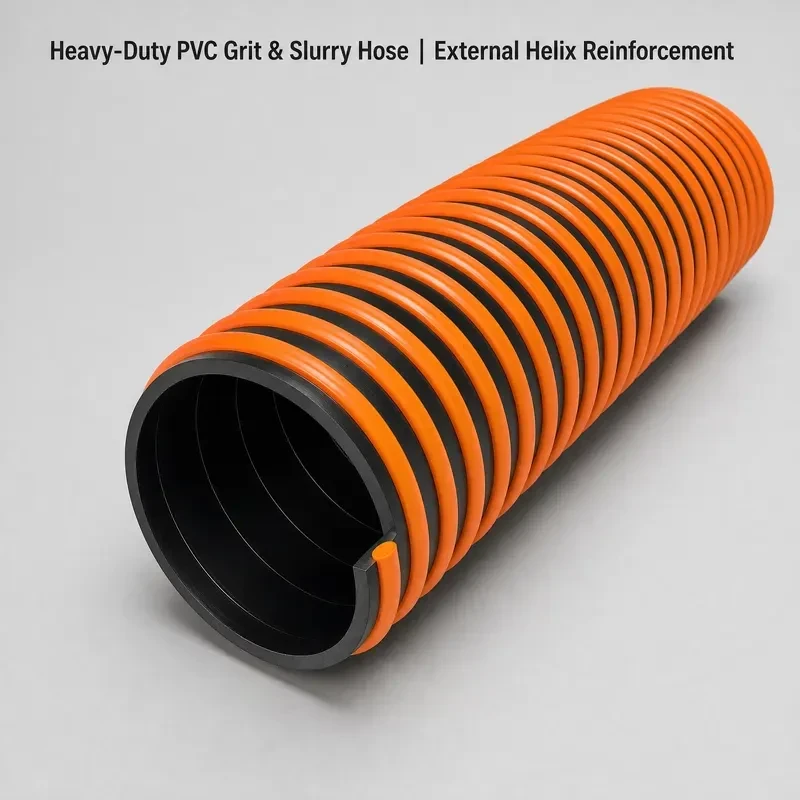
External helix over a soft compound wall: the rib stands proud of the tube, the bore stays smooth.
Element | Material | Function |
|---|---|---|
Outer helix | Rigid yellow PVC spiral | Crush resistance, sacrificial wear rib, high visibility on site |
Wall | PVC and rubber soft compound | Absorbs particle impact, resists oil, fuel and UV |
Bore | Mirror-smooth interior | Low friction, reduced material hang-up |
Profile | Corrugated exterior | Axial flexibility and tight bending radius |
The compound is the part that decides wear life. Rubber contributes elasticity and tear strength, PVC contributes chemical resistance and keeps the hose light enough to handle. The blend stays soft in service, so grit rebounds off a surface that gives slightly rather than fracturing a rigid wall. The yellow helix is pigmented for visibility as well as wear: on a bridge deck or in a plant walkway, a bright rib is easier to see than a grey tube.
Smooth Bore, Corrugated Outside
The inside is smooth and the outside is ribbed. That combination is deliberate. A smooth bore keeps pressure drop low and stops fine dust from packing into grooves; a corrugated exterior lets the hose bend through tight radii without kinking, which is what allows it to follow a duct cleaning brush or route around a machine frame.
In duct cleaning work the same properties matter in a different way: the hose has to pass through ceiling voids and around plenum corners while carrying lint, insulation fibre and heavy dust without the bore loading up.
Pressure and Vacuum Duty
The rigid helix carries the compressive load, so the hose holds its bore under strong suction on a vacuum truck or a dust collector intake. On the delivery side it also takes positive pressure from pneumatic blasting and slurry discharge, within the rated working pressure for the bore size.
Two practical rules apply. Keep the bend radius generous at the suction head, because a partly closed bore concentrates both wear and flow. And check the coupling, since a loose hose clamp on a pressurised line is a more common failure than a worn wall.
Temperature Rating
The standard hose runs from -10 °C to +60 °C. A heavy-duty variant covers -20 °C to +80 °C for colder sites and warmer process media. Both are intended for ambient industrial duty rather than hot gas: for exhaust above 100 °C, a silicone or high-temperature ducting hose is the correct choice.
Applications
Sandblasting and surface preparation
Recovery and transfer of silica sand, steel shot, garnet and slag in shipyards, bridge works and steel fabrication shops. The soft wall absorbs the impact that would chip a rigid tube at the bend.
Commercial air duct and HVAC cleaning
High-vacuum removal of heavy dust, lint, debris and insulation from commercial ductwork. The smooth bore keeps fibre from catching, and the flexible profile follows the run.
Bridge, infrastructure and concrete cleaning
Concrete dust, hydro-demolition slurry and abrasive cleaning residue, where the hose is dragged along rough surfaces and has to stay visible to plant operators.
Slurry, dredging and tailings discharge
The same construction is used for heavy slurry lines on dredgers, excavator-mounted pumps and tailings discharge, where abrasive solids travel with water at high velocity. The image below shows a discharge line running over the water on a dredger.
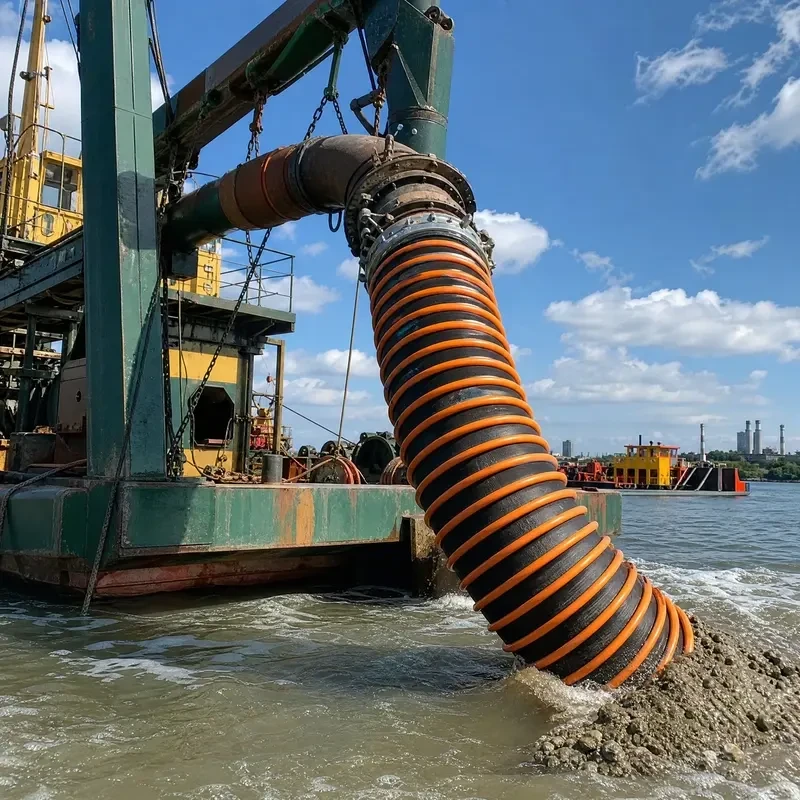
Dredger discharge: abrasive slurry at high velocity, hose supported on a lifting frame.
Industrial dust, foundry and mobile vacuum
Dust collectors, woodworking plants, foundry exhaust, agricultural dry material handling, mobile vacuum loaders and tractor pull exhaust systems.
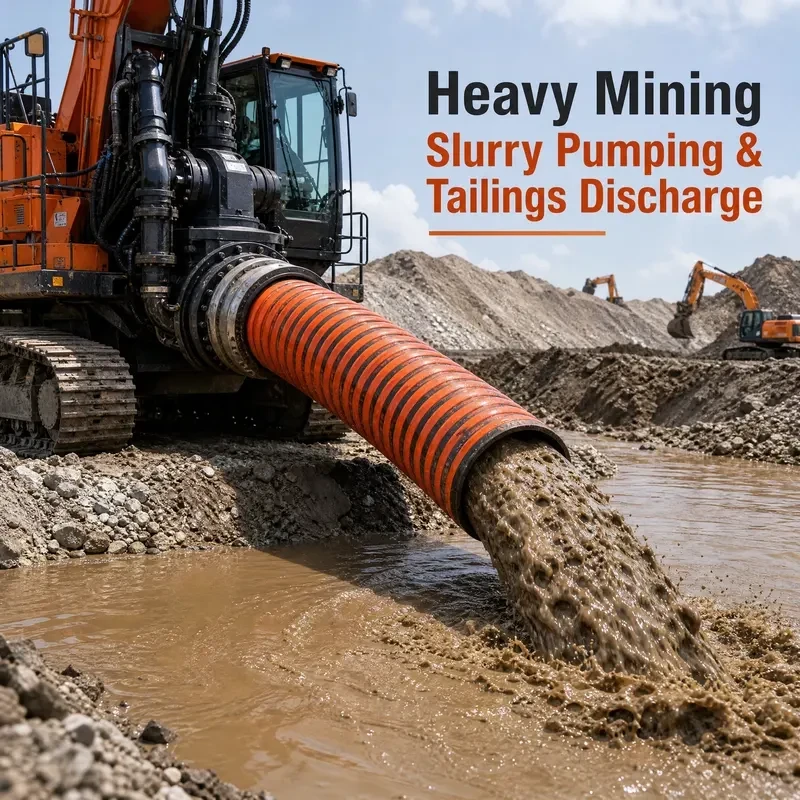
Mine site slurry pumping: the hose takes both vacuum at the intake and pressure at the discharge.
Technical Specifications
Parameter | Specification |
|---|---|
Wall material | Abrasion-resistant soft PVC and rubber compound |
Reinforcement | External raised rigid PVC helix, safety yellow |
Bore | Mirror-smooth interior |
Outside profile | Corrugated, spiral ribbed |
Temperature | -10 °C to +60 °C standard, -20 °C to +80 °C heavy-duty variant |
Bore sizes | 51 mm to 203 mm standard, metric and imperial |
Standard coil | 20 m, custom cut lengths available |
Pressure | Rated for positive and negative pressure duty |
Media | Silica sand, steel grit, mineral dust, slurry, oil, fuel, UV, ozone |
Manufacture and Bulk Supply
The hose is produced by continuous extrusion and then run through a water bath to set the helix and the wall together. Cooling in line keeps the rib bonded to the tube along its full length, which is what stops the helix peeling away at the end after a season of dragging.

Continuous extrusion into a water bath: helix and wall set together along the full length.
Coils are wrapped, strapped and palletised for export, so a distributor can hold several diameters in one rack position without the bore being crushed in transit. Custom diameters, colours, coil lengths and print are available for OEM orders.
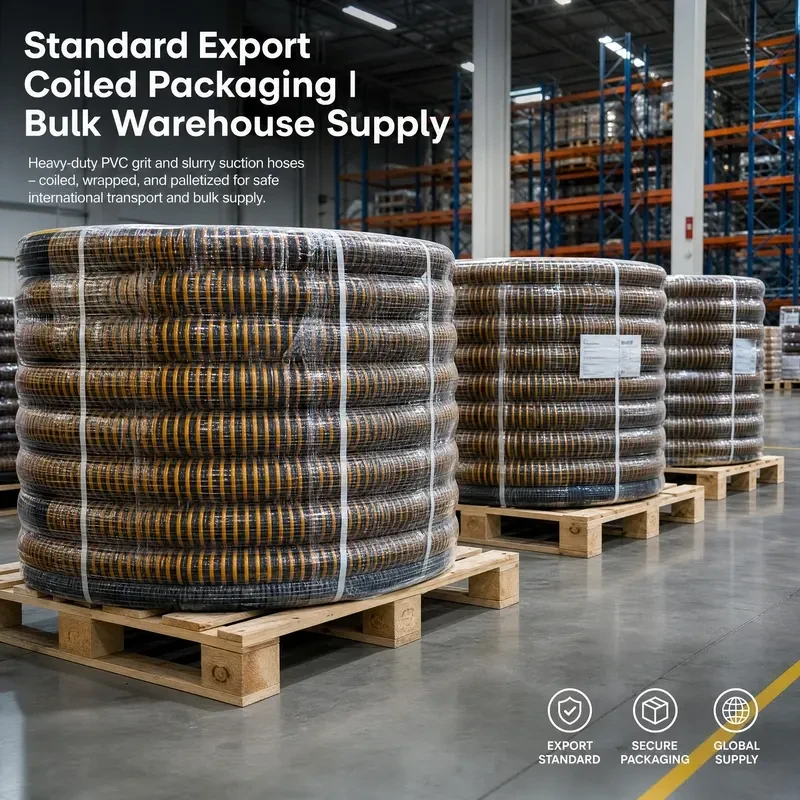
Export packaging: wrapped coils on pallets, strapped for bulk supply.
Installation and Care
Support the hose at the head. A full grit hose is heavy; a hanger near the pickup stops the wall carrying the load.
Keep bends wide on the suction side. A kink closes the bore and speeds up wear at that point.
Rotate the hose periodically on a permanent run so wear is spread around the wall instead of concentrated on one side.
Check the helix at both ends — couplings and dragging damage the rib first.
Empty the bore after slurry duty so settled solids do not set inside the corrugation.
Match the coupling to the application; a loose clamp leaks air on suction and is the weak point on pressure.
Frequently Asked Questions
What is the hose made of?
A soft PVC and rubber compound wall with an external rigid yellow PVC helix. The bore is smooth and the outside is corrugated.
Why use a PVC and rubber blend instead of plain PVC?
Rubber adds elasticity and tear strength, so the wall absorbs particle impact instead of chipping, while PVC keeps the hose light and chemically resistant.
What temperature range is available?
-10 °C to +60 °C standard, or -20 °C to +80 °C with the heavy-duty variant.
What bore sizes and lengths are supplied?
51 mm to 203 mm as standard, on 20 m coils. Custom lengths, diameters and colours are available.
Can it be used for both suction and pressure?
Yes. The helix resists vacuum collapse and the wall is rated for positive pressure; confirm the working pressure for your bore size before use.
Is it suitable for sandblasting recovery?
Yes. Silica sand, steel shot, garnet and slag recovery are core duties for this hose.
Can it be used for HVAC duct cleaning?
Yes. The smooth bore carries lint, insulation fibre and heavy dust without loading up, and the corrugated outside follows ceiling voids.
Is it suitable for hot exhaust?
No. For exhaust above 100 °C use a silicone or high-temperature ducting hose instead.
Choosing the Right Hose
For abrasive media at high velocity this hose is the starting point. The PVC ducting range covers lighter air and fume versions, the TPR ducting range covers another abrasion-resistant option, and the PVC braided suction and discharge hose guide covers water and slurry pumping with a polyester braid. For a wall or bore recommendation, a sample or a bulk quotation, contact the ECOOSI technical team.
Related Articles
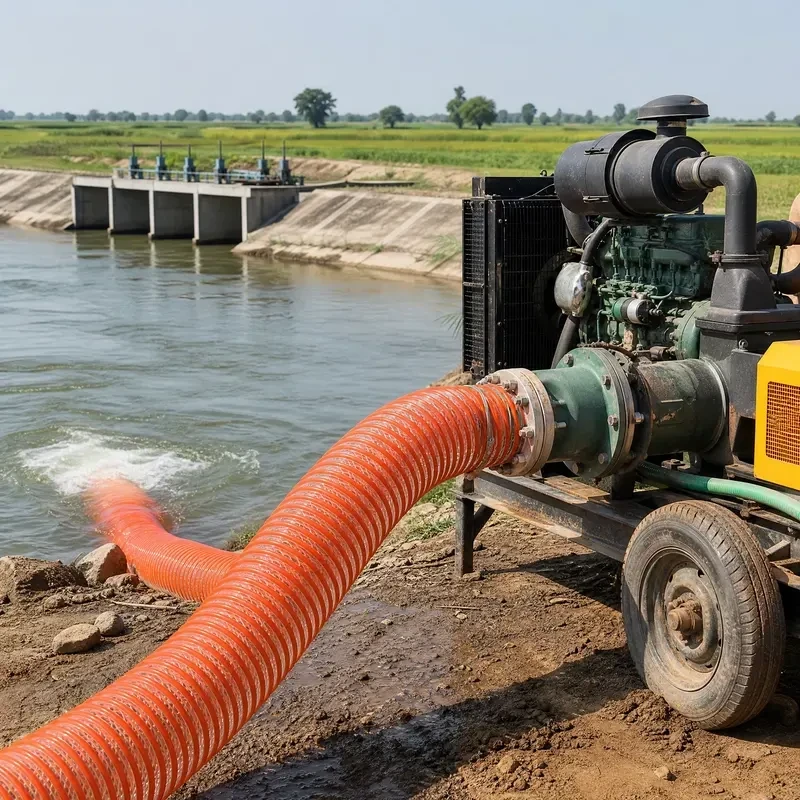
PVC Braided Suction and Discharge Hose: Fibre-Reinforced Helix Guide for Pumps and Dewatering
Guide to the ECOOSI PVC braided suction and discharge hose: double-ply virgin PVC wall, polyester braid for pressure, rigid orange PVC helix for vacuum, -20 to +65 °C, 25-150 mm bore, 20 m coils for trash pumps, dewatering, tankers and aquaculture.
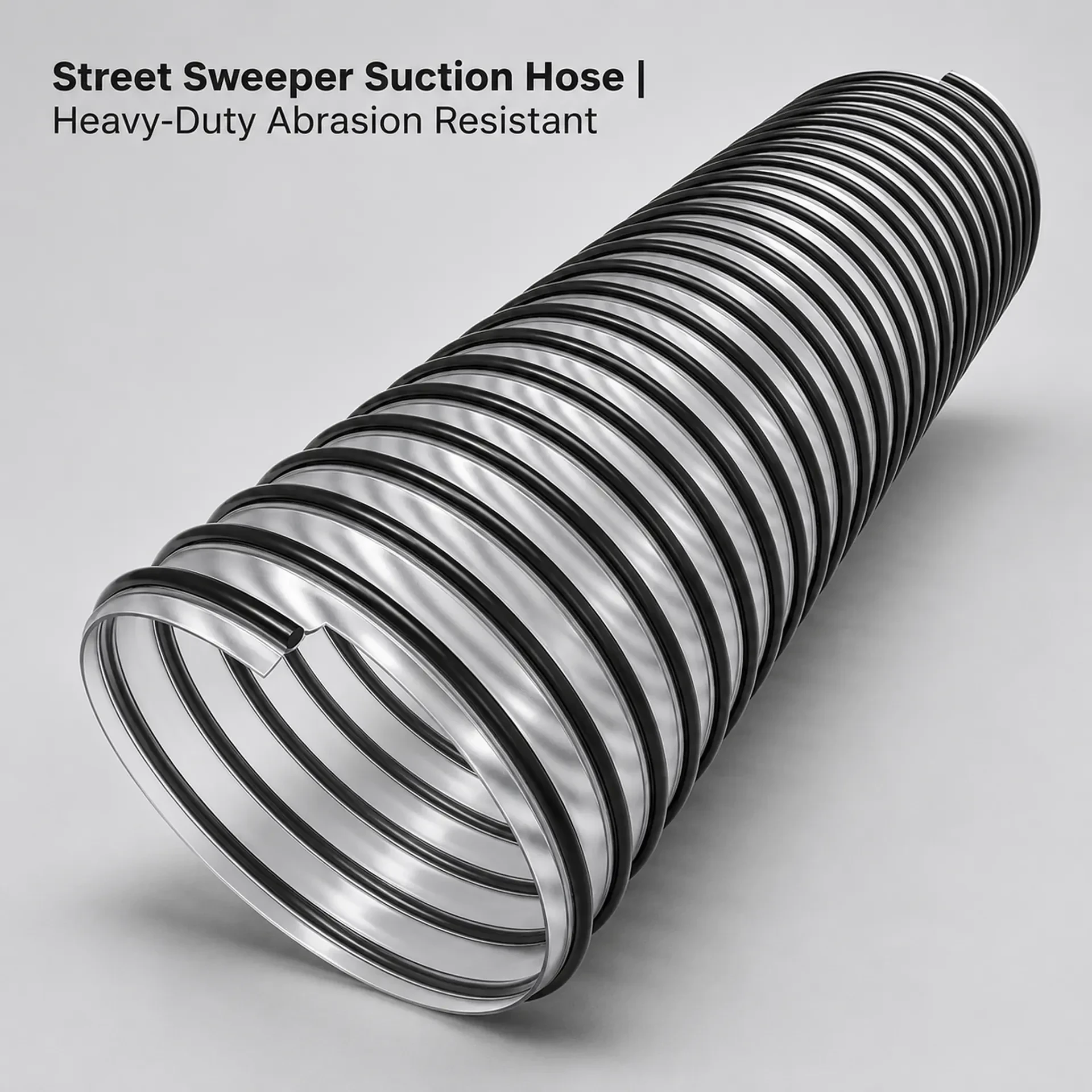
Municipal Street Sweeper PU Suction Hose: Wear-Strip and Copper-Plated Helix Guide
Guide to the ECOOSI heavy-duty polyurethane sweeper hose: 0.9 mm Pre-PUR wall, copper-plated spring steel helix, external black wear strip, -40 to +100 °C with peaks to +125 °C, 10 m coils for street sweepers, runway vacuum trucks and industrial vacuum systems.
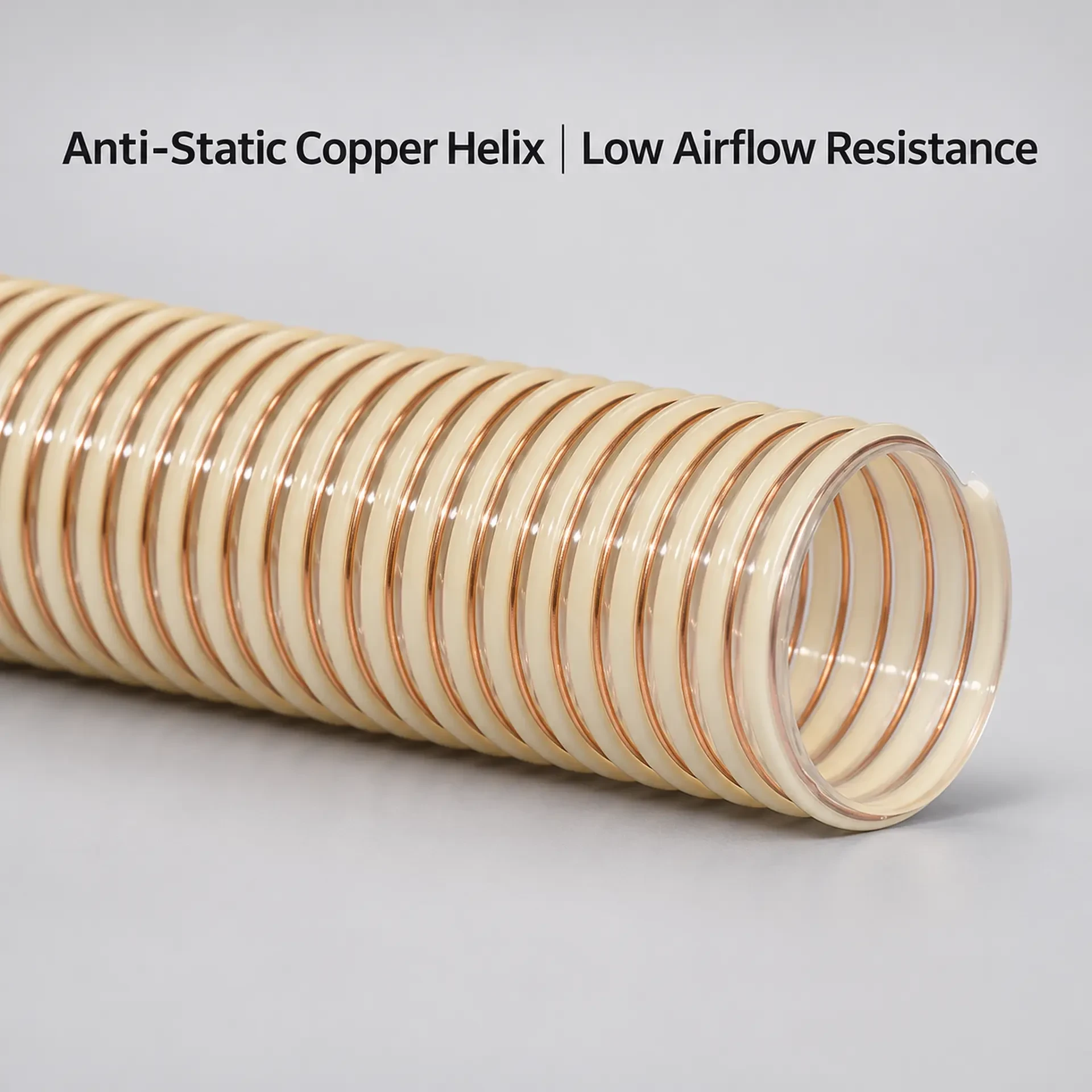
Anti-Static PU Material Handling Hose: Copper Wire Helix Guide for Grain, Sand and Plastic Pellets
Guide to the ECOOSI anti-static polyurethane material handling hose: rigid PVC helix, embedded copper grounding wire below 10^8 ohm, smooth bore, -40 to +90 °C with peaks to +125 °C, 25-300 mm bore for grain, sand, plastic pellets and wood chips.