
Municipal Street Sweeper PU Suction Hose: Wear-Strip and Copper-Plated Helix Guide
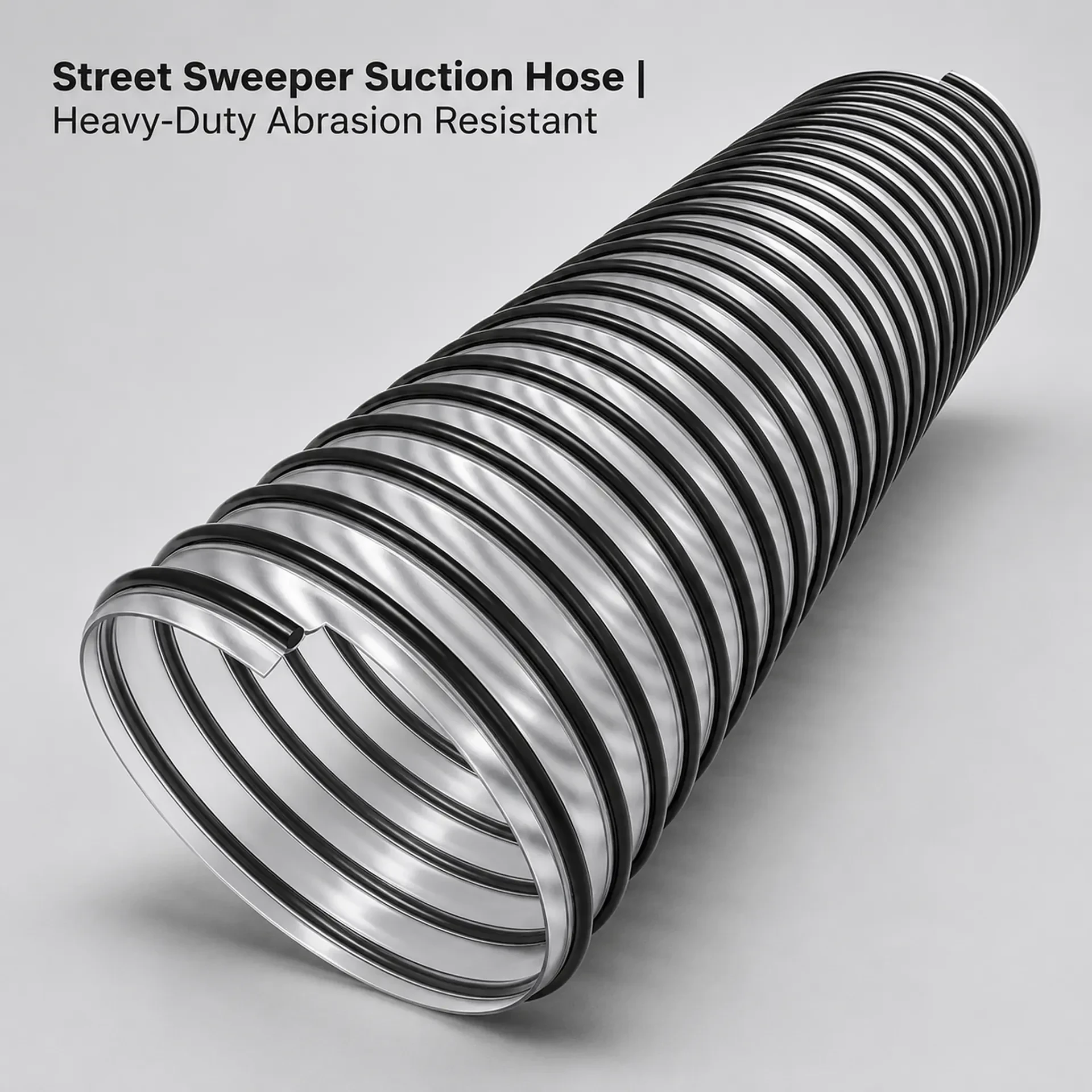
Guide to the ECOOSI heavy-duty polyurethane sweeper hose: 0.9 mm Pre-PUR wall, copper-plated spring steel helix, external black wear strip, -40 to +100 °C with peaks to +125 °C, 10 m coils for street sweepers, runway vacuum trucks and industrial vacuum systems.
The ECOOSI municipal sweeper hose is a 0.9 mm polyurethane suction hose built for street sweepers, runway vacuum trucks and industrial vacuum systems. A copper-plated spring steel helix is embedded in the wall to stop the hose collapsing under suction, an external black wear strip protects the folds that drag on asphalt, and the Pre-PUR compound is formulated for road oils, fuel splash and microbial growth. The standard range is -40 °C to +100 °C with intermittent peaks to +125 °C, and a high-temperature variant covers -40 °C to +125 °C with peaks to +150 °C. Standard supply is 10 m coils.
This guide covers why sweeper hoses fail, how the construction addresses each failure, the temperature and static behaviour, the specifications, and the applications the hose is specified for.
Why Sweeper Hoses Fail Early
A sweeper hose works in one of the harshest positions on the vehicle. It hangs from a suction boom, bends through a tight chassis route and drags its outer folds over wet asphalt hundreds of times a shift. Four failure modes account for most replacements:
- Outer wall abrasion — the hose is dragged on the ground, so the folds wear through before the bore does.
- Vacuum collapse — a weak helix flattens under deep suction, the bore closes and the suction head stops picking up.
- Bore wear from sharp debris — glass, gravel, asphalt chips and metal shavings act like a grinding medium.
- Weather and chemistry — road salt, diesel splash, engine oil and UV attack the compound from outside, and standing moisture encourages microbial growth inside.
Each of those is addressed by a specific part of the construction rather than by making the wall thicker everywhere.
Construction: 0.9 mm Pre-PUR Wall, Copper-Plated Helix and Wear Strip
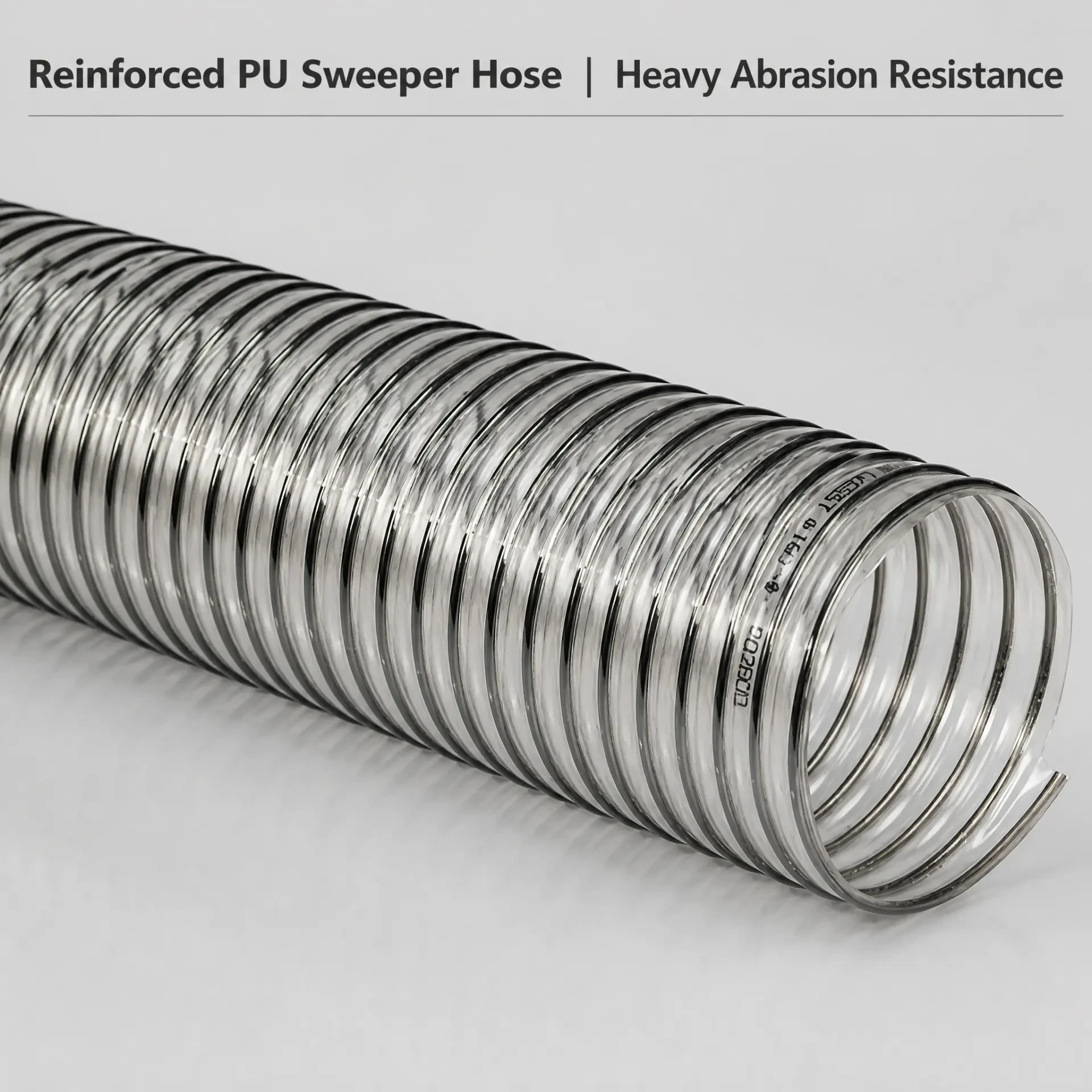
| Element | Material | Function |
|---|---|---|
| External wear strip | Black high-abrasion PU rib | Takes ground drag and impact instead of the hose wall |
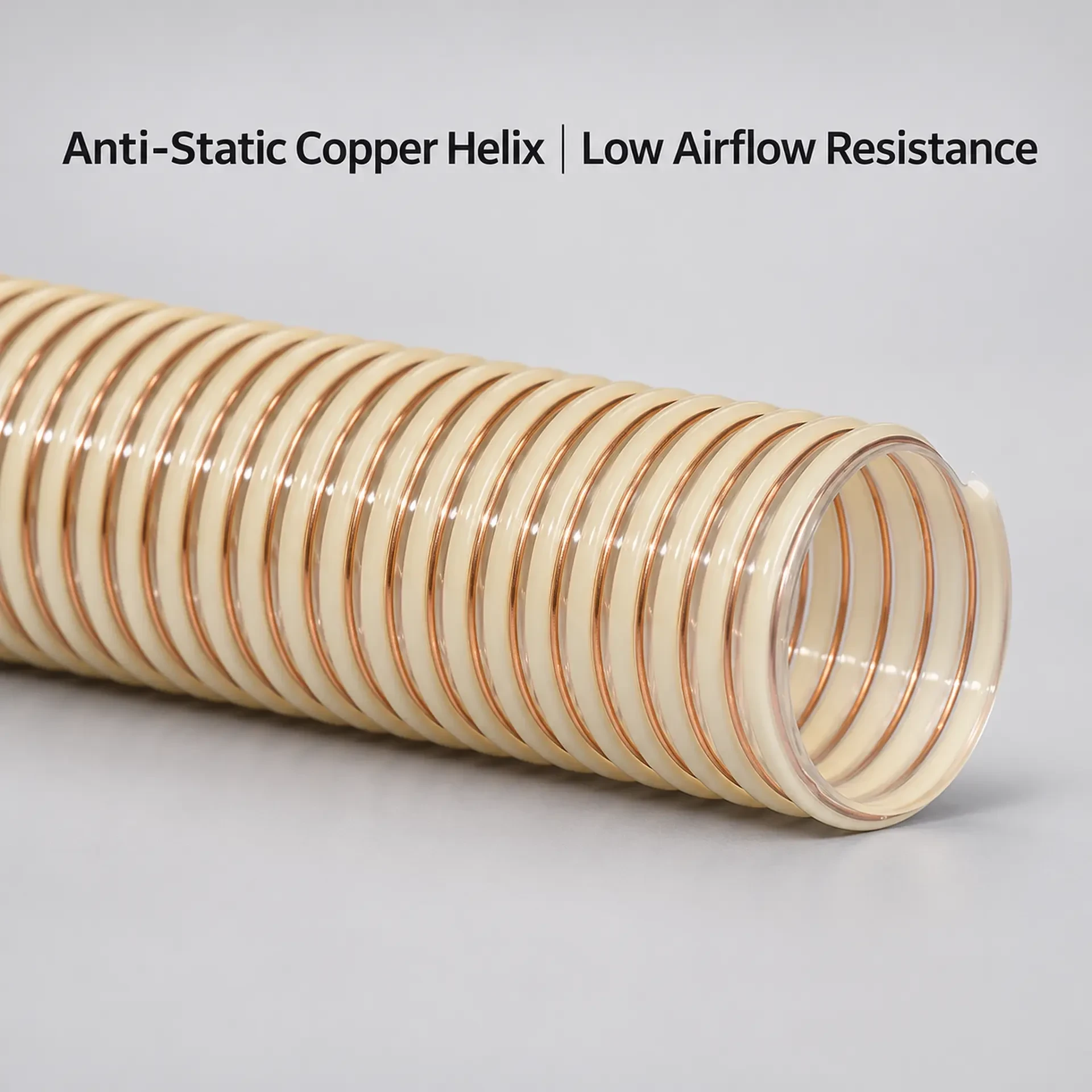
| Helix | Copper-plated high-tensile spring steel | Prevents vacuum collapse, provides a groundable path |
| Wall | 0.9 mm Pre-PUR, polyether and ester based | Abrasion resistance, oil and fuel resistance, microbial resistance |
| Profile | Integrally formed raised corrugation | Compressibility for chassis routing, reduces drag on conveyed solids |
The raised profile is not cosmetic. The corrugation lets the hose compress along the chassis and bend without kinking at the suction head, while the raised ribs stand the wall away from the road surface so only the strip contacts asphalt. Because the profile is formed in one extrusion rather than assembled from a separate sleeve and a glued rib, there is no bond line to delaminate after a winter of wet dragging.
Wear Resistance in Practice
Polyurethane is the standard choice for abrasive conveying because it combines elasticity with high tear strength: grit tends to rebound off the wall instead of cutting into it, which is why PU hose outlasts PVC and rubber in this duty. The 0.9 mm wall is a deliberate middle-heavy gauge — thick enough for glass and gravel at the suction head, thin enough to stay light and flexible on a boom that swings several times a minute.
Wall thickness can be specified from 0.6 mm to 2.0 mm. For municipal fleets running a mixed street load, 0.9 mm is the usual balance; for shot blasting recovery or crushed glass, go heavier and expect a shorter service interval at the head end.
Vacuum Stability and Chassis Routing
The helix is copper-plated spring steel encapsulated in the PU wall. It is there for two reasons. Mechanically, it holds the bore circular under the suction of a vacuum truck, where a light hose would flatten and stall the pickup. Electrically, it gives the hose a continuous conductor that can be bonded to the vehicle chassis, so charge generated by fast-moving dry debris has a path away from the surface.
Grounding has to be done deliberately: bond the helix at the vehicle end and check continuity with a meter. An ungrounded anti-static hose behaves much like a standard hose and can still hold charge.
Temperature Range and Weather Behaviour
The standard hose runs from -40 °C to +100 °C with intermittent peaks to +125 °C. Two variants matter to fleet buyers:
- Cold climates — PU stays flexible well below freezing, so the hose does not stiffen and crack at the helix during winter sweeping. PVC hose is the usual comparison point and is where most cold-weather failures come from.
- Hot wash or hot exhaust exposure — the extended variant covers -40 °C to +125 °C with peaks to +150 °C, for installations near engine compartments or hot wash-down equipment.
The compound also resists hydrolysis, which matters for hoses that stay wet between shifts, and it is formulated against microbial growth in standing water inside the bore.
Applications
Municipal sanitation fleets
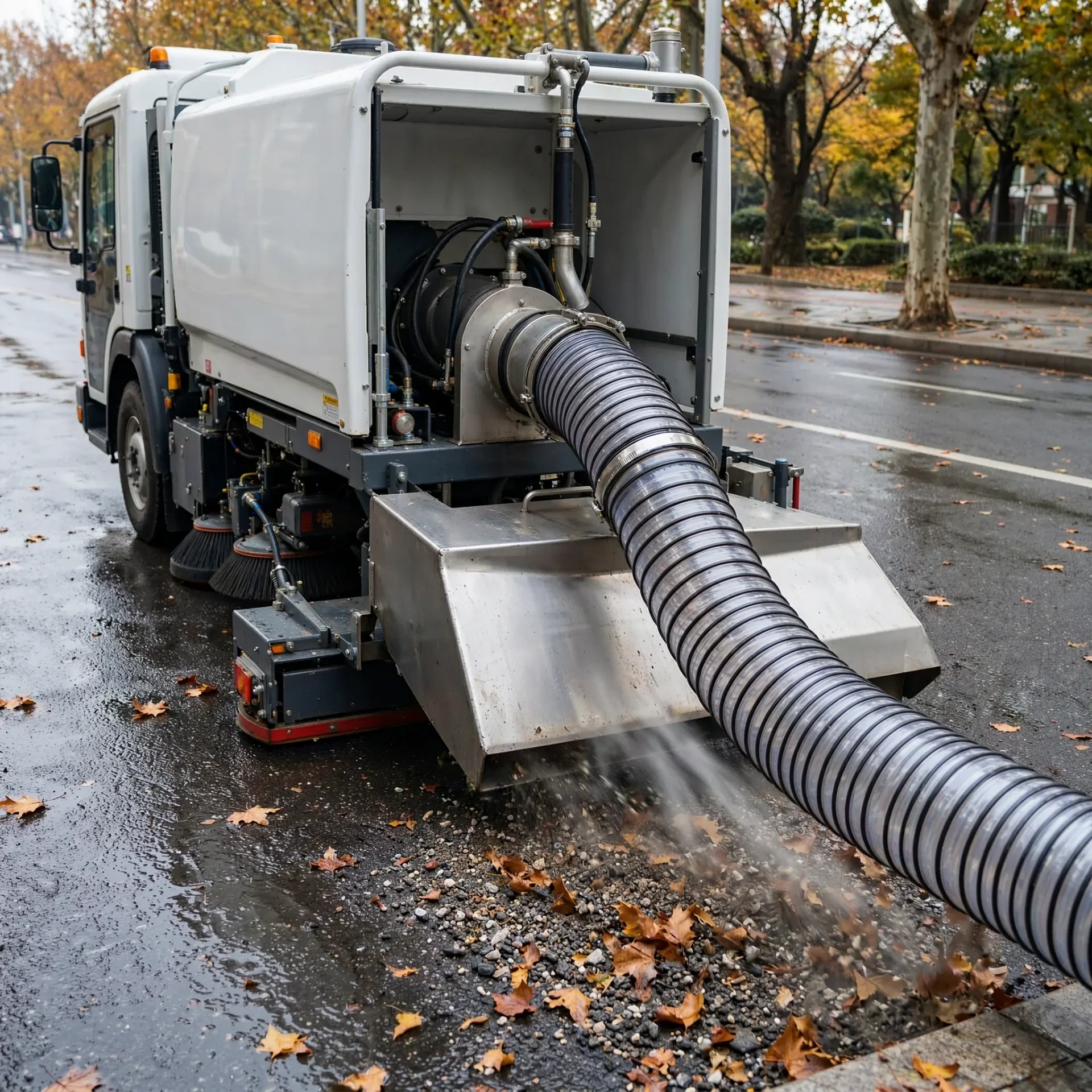
Suction and transfer lines for street sweepers, road washing trucks, compact sidewalk sweepers and vacuum leaf collectors. The hose in the picture below is the suction line running from the pickup head to the hopper.
Airport and highway maintenance
Runway debris sweepers, high-speed road maintenance vehicles and tarmac vacuum machines, where the hose has to survive continuous drag on rough aggregate.
Heavy industrial cleaning
Central industrial vacuum systems, shot blast recovery and mobile vacuum loaders handling sand, shot and metal fines.
Woodworking, landscaping and dry bulk
Sawdust extraction, wood chip and bark suction, grain handling, and commercial mower leaf collection where the hose trails behind the machine across turf and kerbs.

Technical Specifications
| Parameter | Standard | High-temperature variant |
|---|---|---|
| Wall material | Pre-PUR, ester and polyether based, halogen-free and plasticizer-free | Same compound, high-heat grade |
| Wall thickness | 0.9 mm | 0.6 mm to 2.0 mm on request |
| Helix | Copper-plated high-tensile spring steel, encapsulated | Same |
| External protection | Black high-abrasion reinforcement strip | Same |
| Temperature | -40 °C to +100 °C, peak +125 °C | -40 °C to +125 °C, peak +150 °C |
| Standard length | 10 m coil | 10 m coil |
| Appearance | Transparent with black spiral rib | Black, transparent or custom colour |
| Static | Groundable through the encapsulated copper-plated helix | Same |
| Media resistance | Petrol, diesel, engine oil, grease, microbes, ozone, UV | Same |
Manufacture, OEM and Supply
The hose is produced on a continuous extrusion line, which is what allows the wall, the helix and the wear strip to be formed in one pass with a consistent bond. For distributors ordering under their own label, the line runs bulk OEM production with custom diameters, wall gauges, colours and coil lengths, and hoses are supplied coiled and strapped for compact freight.

Installation and Maintenance
- Leave slack at the boom. A hose pulled straight between two fixed points loads the helix and shortens life; a gentle loop absorbs the boom movement.
- Check the wear strip, not just the bore. Most sweeper hoses fail from the outside in. Replace when the black rib is worn down to the wall.
- Bond the helix to the chassis and confirm continuity after any hose change.
- Flush the bore at the end of a wet shift to stop grit and organic debris sitting in the corrugation.
- Do not lift the hose by the suction head when it is full of wet leaves; the weight loads the coupling.
- Match the cuff to the machine — the suction head and hopper inlet usually need different fittings, and a loose cuff leaks air and cuts pickup performance.
Frequently Asked Questions
What is the hose made of?
A 0.9 mm Pre-PUR wall with an encapsulated copper-plated spring steel helix, finished with an external black high-abrasion wear strip.
What temperature range does it cover?
-40 °C to +100 °C continuous with peaks to +125 °C. A high-temperature variant covers -40 °C to +125 °C with peaks to +150 °C.
Why does the hose have a raised corrugated profile?
The profile adds compressibility for tight chassis routing and keeps most of the wall clear of the road, so the wear strip takes the abrasion instead of the hose body.
Can it be grounded to prevent static build-up?
Yes. The copper-plated steel helix acts as a continuous conductor; bond it to the vehicle chassis and check continuity.
What media can it handle?
Gravel, grit, glass, sand, wet leaves, road debris, sawdust, wood chips, grain, shot and general industrial dust.
Is it available in other wall thicknesses?
Yes, from 0.6 mm to 2.0 mm. Heavier walls suit crushed glass and shot blasting recovery; lighter walls suit leaf and litter collection.
What length is supplied?
10 m coils as standard. Custom lengths, diameters and colours are available for OEM orders.
Will it resist diesel and engine oil splash?
Yes. The Pre-PUR compound is formulated for petrol, diesel, engine oils and grease, and it resists hydrolysis and microbial growth in wet service.
Choosing the Right Suction Hose
For abrasive municipal pickup duty this hose is the starting point. The PU ducting range lists the diameters and wall options, the anti-static PU material handling hose guide covers dry bulk conveying with a copper grounding wire, and the flexible ducting range covers lighter air and fume duty. For a wall thickness recommendation, a sample or a fleet quotation, contact the ECOOSI technical team.
Related Articles
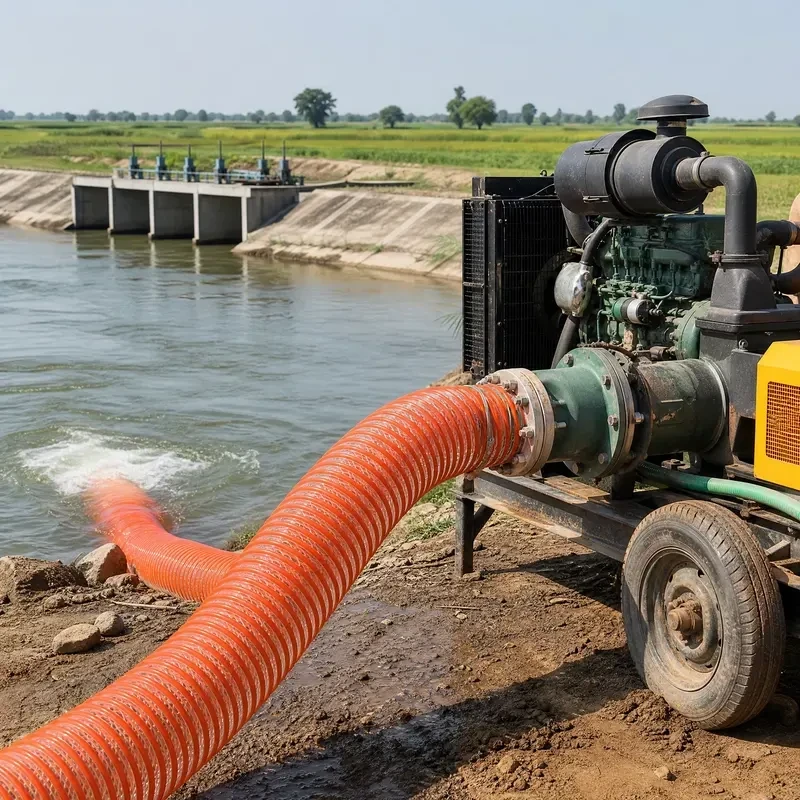
PVC Braided Suction and Discharge Hose: Fibre-Reinforced Helix Guide for Pumps and Dewatering
Guide to the ECOOSI PVC braided suction and discharge hose: double-ply virgin PVC wall, polyester braid for pressure, rigid orange PVC helix for vacuum, -20 to +65 °C, 25-150 mm bore, 20 m coils for trash pumps, dewatering, tankers and aquaculture.
Anti-Static PU Material Handling Hose: Copper Wire Helix Guide for Grain, Sand and Plastic Pellets
Guide to the ECOOSI anti-static polyurethane material handling hose: rigid PVC helix, embedded copper grounding wire below 10^8 ohm, smooth bore, -40 to +90 °C with peaks to +125 °C, 25-300 mm bore for grain, sand, plastic pellets and wood chips.
800 °C High-Temperature Ducting Hose: 3-Layer High-Silica Fiberglass Guide for Furnace and Engine Test Exhaust
Guide to the ECOOSI 800 extreme high-temperature ducting hose: 3-layer coated fiberglass and high-silica composite, external galvanized clamp-profile helix, -60 to +800 °C, 50-1000 mm diameters, for furnace exhaust, engine test cells and hot dust extraction.