
EPDM Rubber Exhaust Hose with Crush-Proof Plastic Helix: Garage Fume Extraction Guide
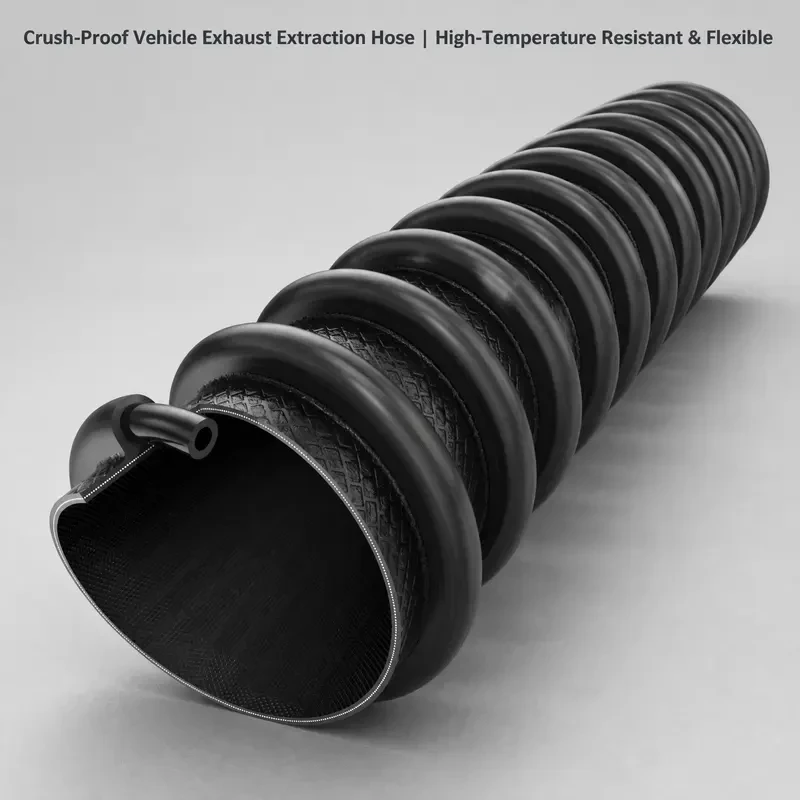
Guide to ECOOSI heavy-duty EPDM exhaust extraction hose: crush-resistant thermoplastic helix that recovers after drive-over, -40 °C to +150 °C with +180 °C peaks, 51 to 203 mm bore, 10 m rolls for hose reels, underfloor channels and dyno cells.
The ECOOSI heavy-duty exhaust extraction hose is an EPDM-coated reinforced fabric tube built on an embedded high-impact thermoplastic helix, rated from -40 °C to +150 °C with intermittent peaks to +180 °C. The plastic spiral is what separates it from wire-reinforced hose: after a car or light truck rolls over it, the wall springs back to round instead of staying flattened, so a bay does not lose extraction every time a vehicle moves.
It is supplied in 10 m rolls from 51 mm to 203 mm bore (2 to 8 inch), in black, yellow, red or blue, for tailpipe extraction on hose reels, in underfloor slots and on overhead rails.
What Actually Kills an Exhaust Hose
Workshop extraction hose fails in four ways, and three of them are mechanical rather than thermal:
- Drive-over crushing. A wire-helix hose that is run over keeps a flat spot. Once the bore is oval it will not seal on the nozzle and will not wind neatly onto the reel.
- Fatigue at the tailpipe. Engine vibration works on the coupling all day. A stiff hose loosens the clamp or cracks at the ferrule.
- Heat and chemical attack. Diesel particulate, oil mist, fuel vapour and ozone harden the wall from the outside in.
- Reel winding. A hose that is too stiff for its reel kinks on the drum, and repeated kinks become leaks.
Temperature is usually blamed first, but in a service bay the drive-over and the reel are what decide how long the hose lasts.
Construction
| Layer | Material | Function |
|---|---|---|
| Outer wall | EPDM-coated reinforced fabric | Heat, ozone, diesel fume, fuel vapour and oil mist resistance |
| Helix | High-impact thermoplastic spiral | Holds the round section and returns to shape after compression |
| Bore | Smooth EPDM surface | Low friction, less soot build-up, lower backpressure |
| Ends | Cuffed and clamped | Gas-tight joint at the nozzle and at the fan inlet |
EPDM is chosen over PVC or plain fabric because it holds up to hot gas, ozone and hydrocarbon vapour at the same time. The wall stays flexible cold, which matters in an unheated bay in winter.
Crush Recovery After Drive-Over
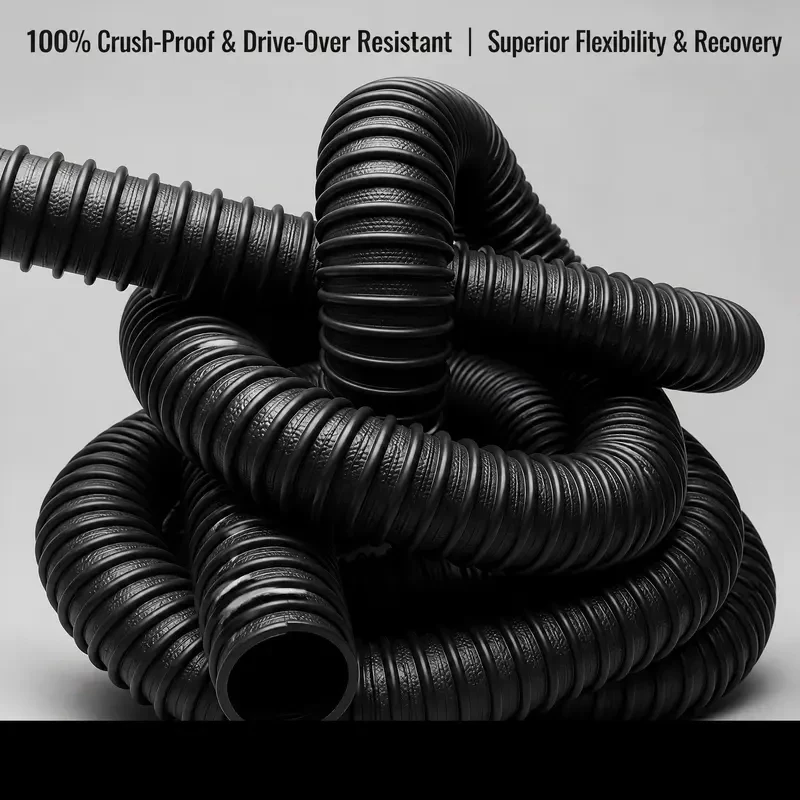
A metal spiral deforms plastically. Once a wire helix is bent past its limit it stays bent, and a flattened hose cannot be repaired. The thermoplastic helix behaves differently: it flexes under load and comes back, which is why the same hose can sit on a floor channel and still seal after a truck has driven across it.
Recovery depends on the load and the temperature, so treat drive-over resistance as a design property, not an unlimited guarantee. Keep the hose clear of sharp edges and of vehicles heavier than the light commercial class it is intended for.
Heat, Vibration and Gas Tightness
| Parameter | Rating |
|---|---|
| Continuous working temperature | -40 °C to +150 °C (-40 °F to +302 °F) |
| Intermittent peak | +180 °C (+356 °F) |
| Media | Gasoline and diesel exhaust, oil mist, fuel vapour, hot air, smoke, small granules |
| Construction | Flame-retardant wall, gas and liquid tight under normal extraction vacuum |
At the tailpipe the hose absorbs engine movement directly rather than transmitting it to the nozzle or the reel arm. That is why the coupling stays tight: the flexible section takes the vibration before it reaches the clamp.
The bore is smooth, so soot does not anchor to the wall the way it does on a corrugated interior. Lower friction means less backpressure on a dynamometer run, where a restriction shows up as a measured power loss rather than a visible problem.
Hose Reels and Overhead Rails
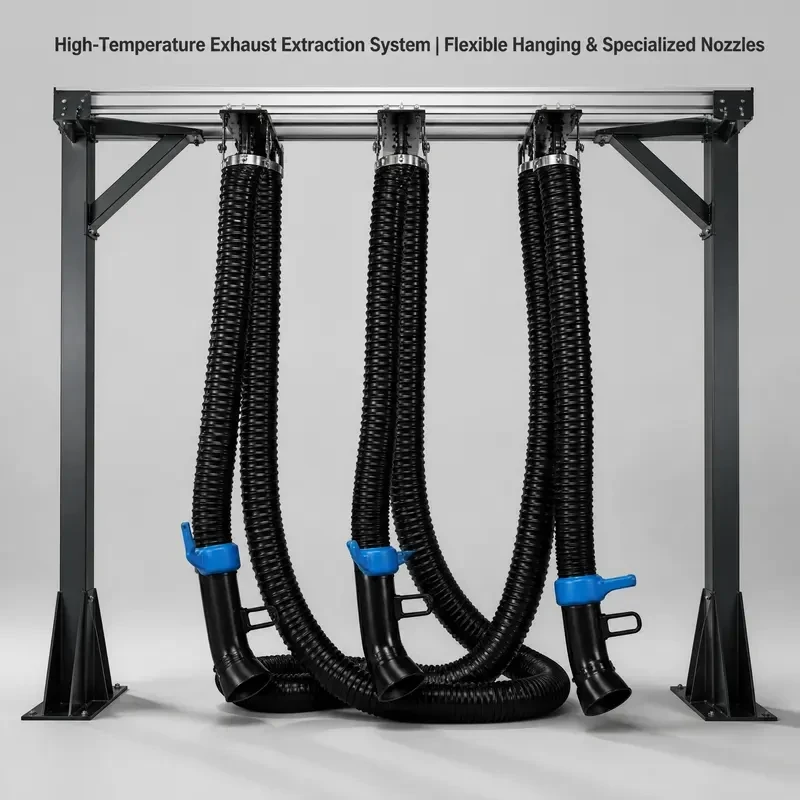
Reel systems ask two things of a hose. First, it has to wind onto a drum of fixed diameter without kinking at the tightest point. Second, the wall has to survive being pulled off the reel hundreds of times a week. A tight bending radius and axial compressibility cover the first; the fabric-reinforced wall covers the second.
On the overhead rail, the hose hangs from a carriage that slides along an aluminium track. Because the tube is light and recovers its shape, it tracks straight instead of swinging out and snagging.
Underfloor Channels
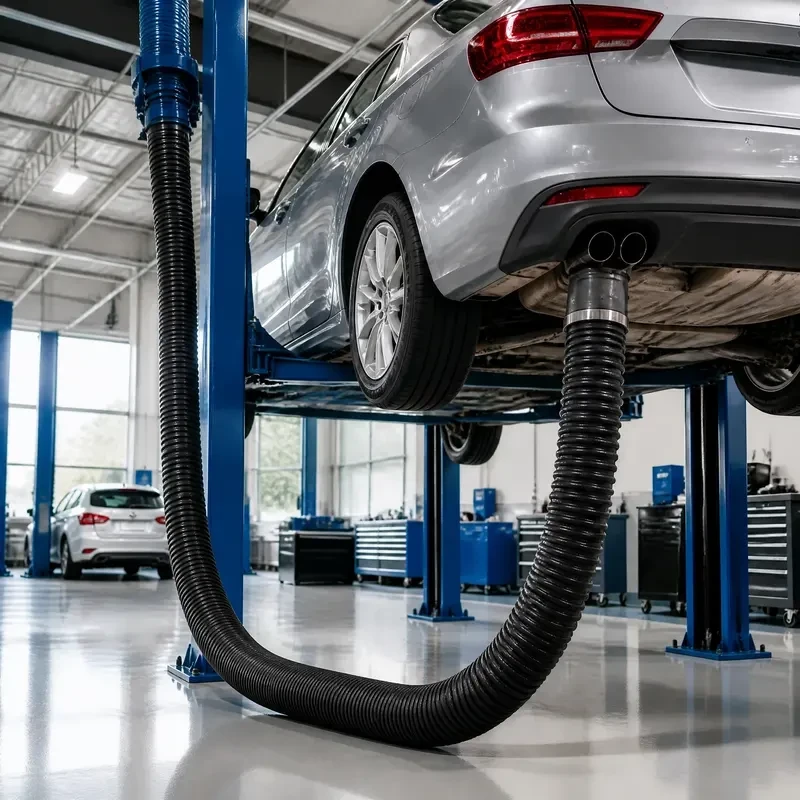
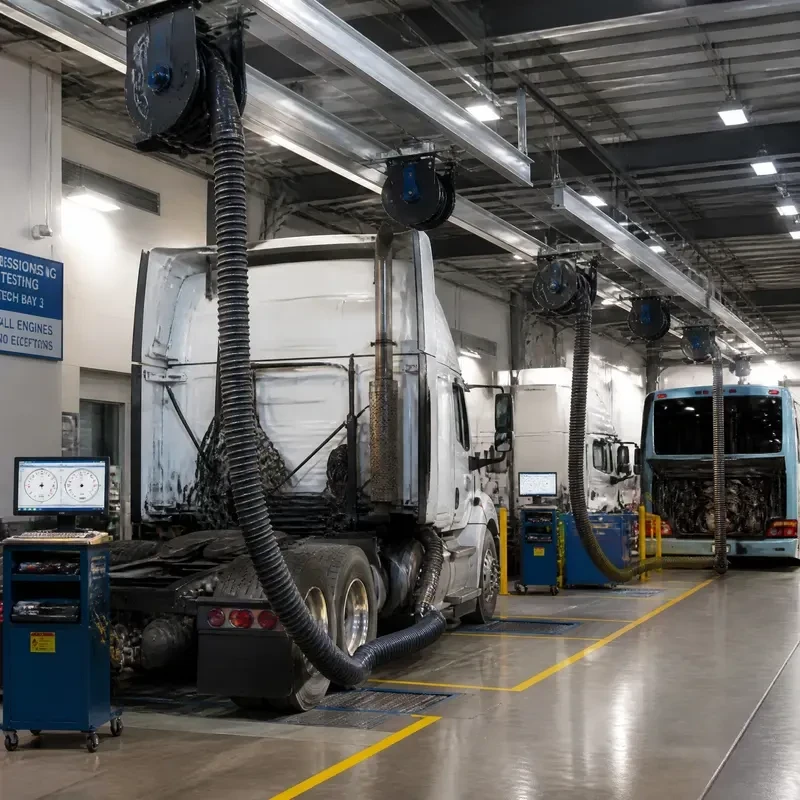
An in-ground system is the harshest environment for the hose: it lies in a slot at floor level, gets rolled over, and has to come back up to the tailpipe without a flat. This is the layout where a plastic helix earns its cost, because a wire hose in the same slot is usually the first thing replaced.
Technical Specifications
| Parameter | Specification |
|---|---|
| Series | Heavy-duty EPDM rubber exhaust hose |
| Wall | EPDM-coated reinforced fabric, gas and liquid tight, flame retardant |
| Helix | High-impact thermoplastic spiral |
| Temperature | -40 °C to +150 °C, peaks to +180 °C |
| Bore | 51 mm to 203 mm (2 to 8 inch standard) |
| Standard roll | 10 m, custom cut lengths available |
| Colours | Black, yellow, red, blue, custom matching |
| Mechanical | Vibration resistant, tight bending radius, axial compressible, drag resistant |
Packaging
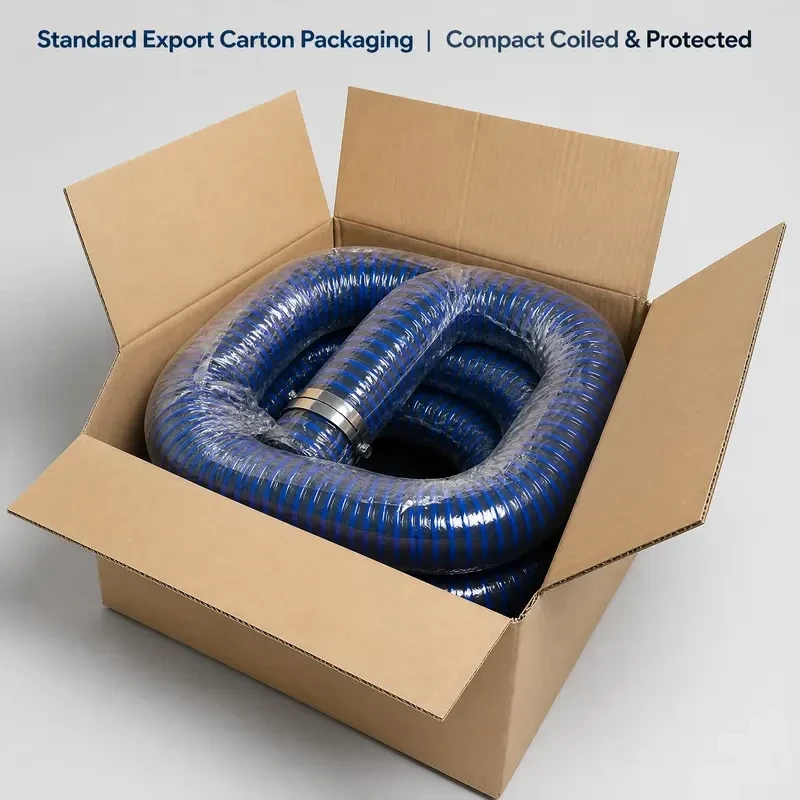
Coils are packed in cartons with the ends protected. Store them flat and out of direct sun; a hose left compressed under weight for months will keep a slight oval for a while before it recovers.
Where It Is Used
Vehicle service centres and dealership workshops
Tailpipe extraction at the lift, in the bay and at the inspection line, including dealership service halls.
Vehicle inspection stations
MOT and TUV style test lanes where vehicles move on and off the extraction point all day and the hose is regularly driven over.
Engine dynamometer and test cells
High-temperature extraction on chassis dynos, engine R and D cells and motorcycle test benches, where backpressure affects the measurement.
Overhead rail and underfloor slot systems
Sliding rail drops, in-ground channels and drive-over floor grilles.
Industrial hot fume and dust
Hot air, chemical vapour and light abrasive solids in plant ventilation where a crush-resistant flexible duct is wanted.
Installation and Maintenance
- Clamp the ferrule, do not tape it. The joint at the nozzle is the first place to leak.
- Leave a hanging loop at the reel so the hose is not pulled straight at full extension.
- Keep the hose off sharp floor edges and out of the path of heavy commercial vehicles.
- Check the slot or channel for debris that can pinch the wall when a wheel passes.
- Inspect the tailpipe end monthly for hardening or soot cracking, and replace the section rather than patching it.
- Do not hang the hose from a single point over a long span; use the reel or the rail carriage as designed.
Frequently Asked Questions
What does crush-proof mean in practice?
The thermoplastic helix flexes and returns to a round section after a car or light truck rolls over the hose, where a wire helix would keep a flat spot.
What temperature can the hose take?
Continuous service from -40 °C to +150 °C, with intermittent peaks up to +180 °C at the tailpipe.
Is it gas tight?
The coated fabric wall and clamped ends are gas and liquid tight under normal extraction vacuum, which is what keeps carbon monoxide and nitrogen oxides out of the bay.
Which bore size do I need?
Match the bore to the tailpipe nozzle and to the fan capacity. Too small adds backpressure; too large is harder to wind on a reel. Standard sizes run from 51 mm to 203 mm.
Will it work on a motorised hose reel?
Yes. The hose is designed for spring-recoil and motorised reels with a tight bending radius and axial compressibility.
Can it be used in an underfloor channel?
Yes, that is one of the main uses: the hose lies in the slot, is driven over, and lifts to the tailpipe without staying flat.
Why EPDM rather than PVC?
EPDM handles hot exhaust gas, ozone and hydrocarbon vapour together and stays flexible when cold; PVC softens and can release hydrogen chloride if it is overheated.
Can I order custom lengths and colours?
Yes. Custom cut lengths and colour matching for bay identification are available, with 10 m rolls as the standard pack.
Choosing the Configuration
If the bay uses a rail or a reel, start from the reel diameter and the nozzle, then pick the bore. For general ventilation ducting see the flexible ducting range, for hotter exhaust duty the high-temperature ducting range, and for the 800 °C class the high-silica fiberglass guide. Send your bay layout, vehicle type and fan capacity to the ECOOSI technical team for a size recommendation.
Related Articles
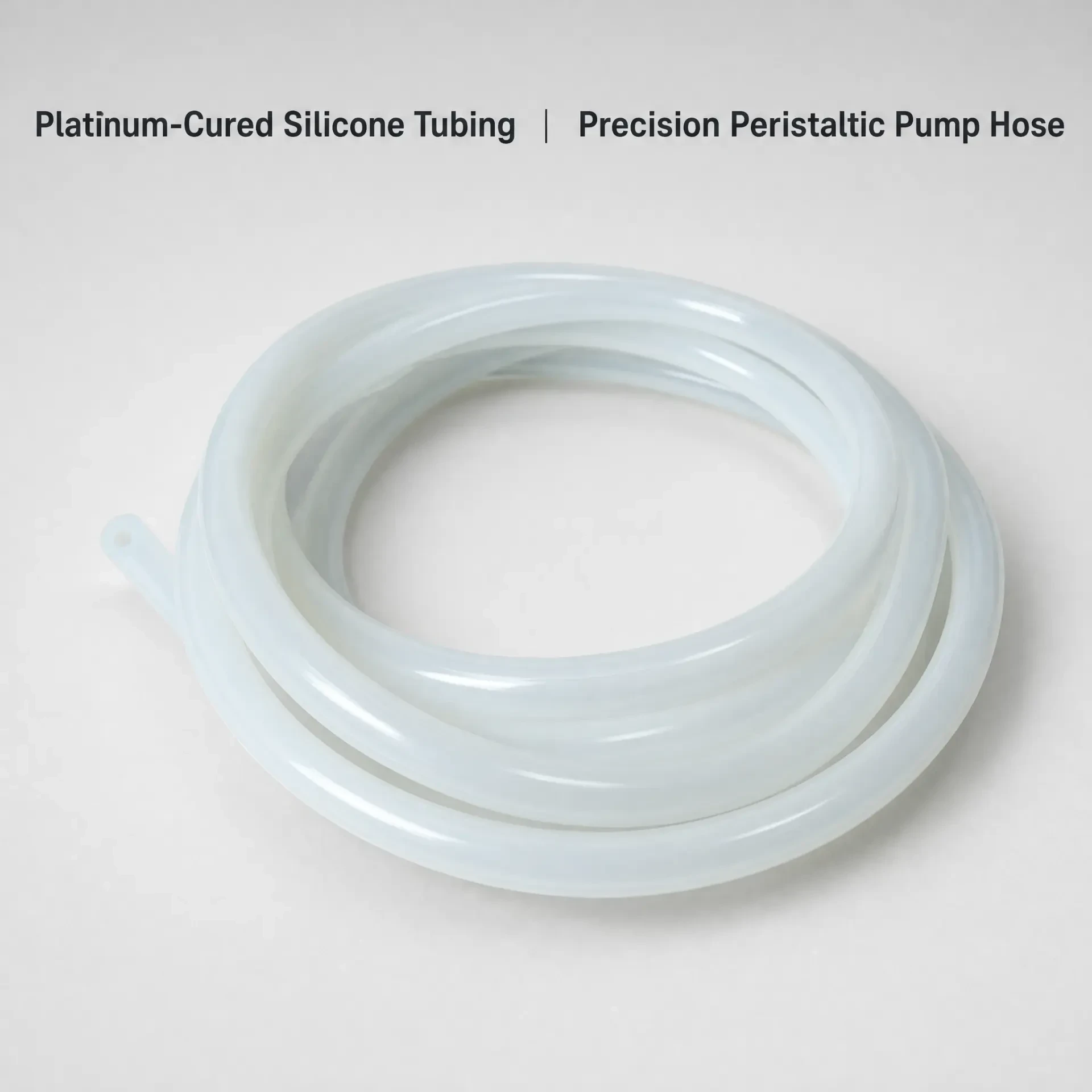
Platinum-Cured Peristaltic Pump Silicone Tubing: Food and Pharma Grade Selection Guide
Selection guide for platinum-cured peristaltic pump silicone tubing: low extractables, smooth high-concentricity bore, -73 °C to +204 °C, steam, EtO and gamma sterilisation, 15 m rolls in sizes 16# to 82# for pharma filling, IVD and food dispensing.
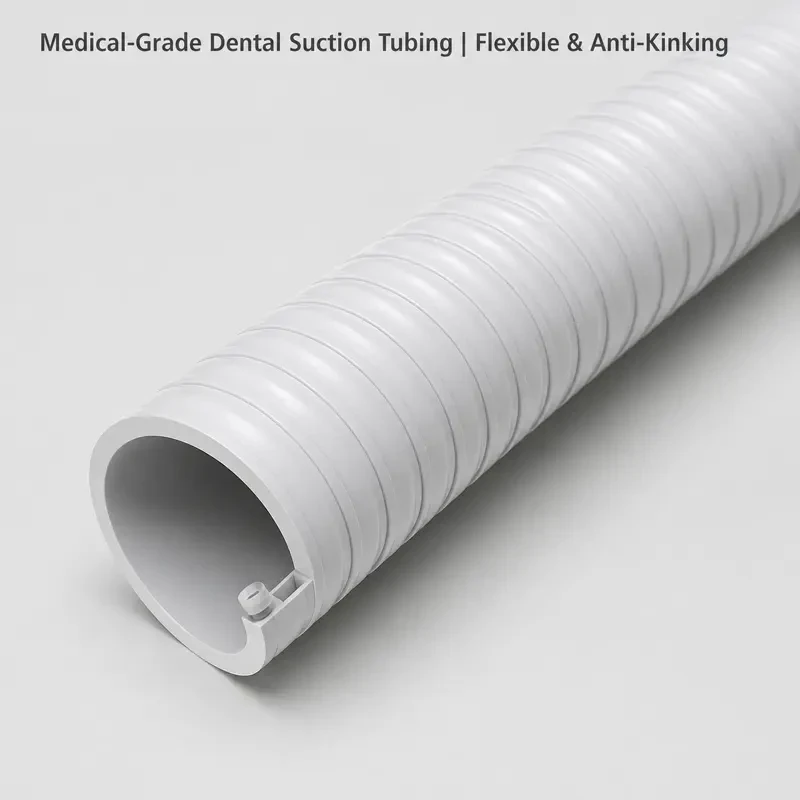
Dental Suction PU Tubing: Double-Layer Latex-Free Guide for HVE and Saliva Ejectors
Guide to the ECOOSI biological-grade double-layer PU dental suction tubing: latex-free and phthalate-free wall, smooth bore and cover, -40 to +90 °C, 10 m coils, for dental chair HVE and saliva ejector lines, oral surgery and medical aesthetic equipment.
ECOOSI High-Temperature Silicone Hoses for Lithium Battery Factories: Withstanding Heat and Corrosion
Discover how ECOOSI high-temperature silicone duct hoses solve the dual challenges of extreme heat and chemical corrosion in lithium battery manufacturing. Learn about key features, applications, and cost benefits.